Carestify Press
RSS FeedStop Looking at the CARFAX Accident Amount — Read the Parts List Instead
July 14, 2026 · Noah Minami
= 2 headlights + bumper
on damaged vehicles (Canada)
with damage history
includes radiator damage
The Vehicle That Started This Conversation
This week I took in a 2017 BMW 330i with the M Sport package for reconditioning and sale. When I pulled the CARFAX Canada report, the accident section showed a single claim with a repair total just under $10,000 CAD.
I already knew what that number meant before I read the details. But I went through the parts list anyway, because this is exactly the kind of vehicle where the CARFAX dollar figure creates a false impression for most buyers.
The repair consisted of:
- Two replacement headlight assemblies (driver and passenger side)
- Front bumper assembly replacement
- Associated labour and paint matching
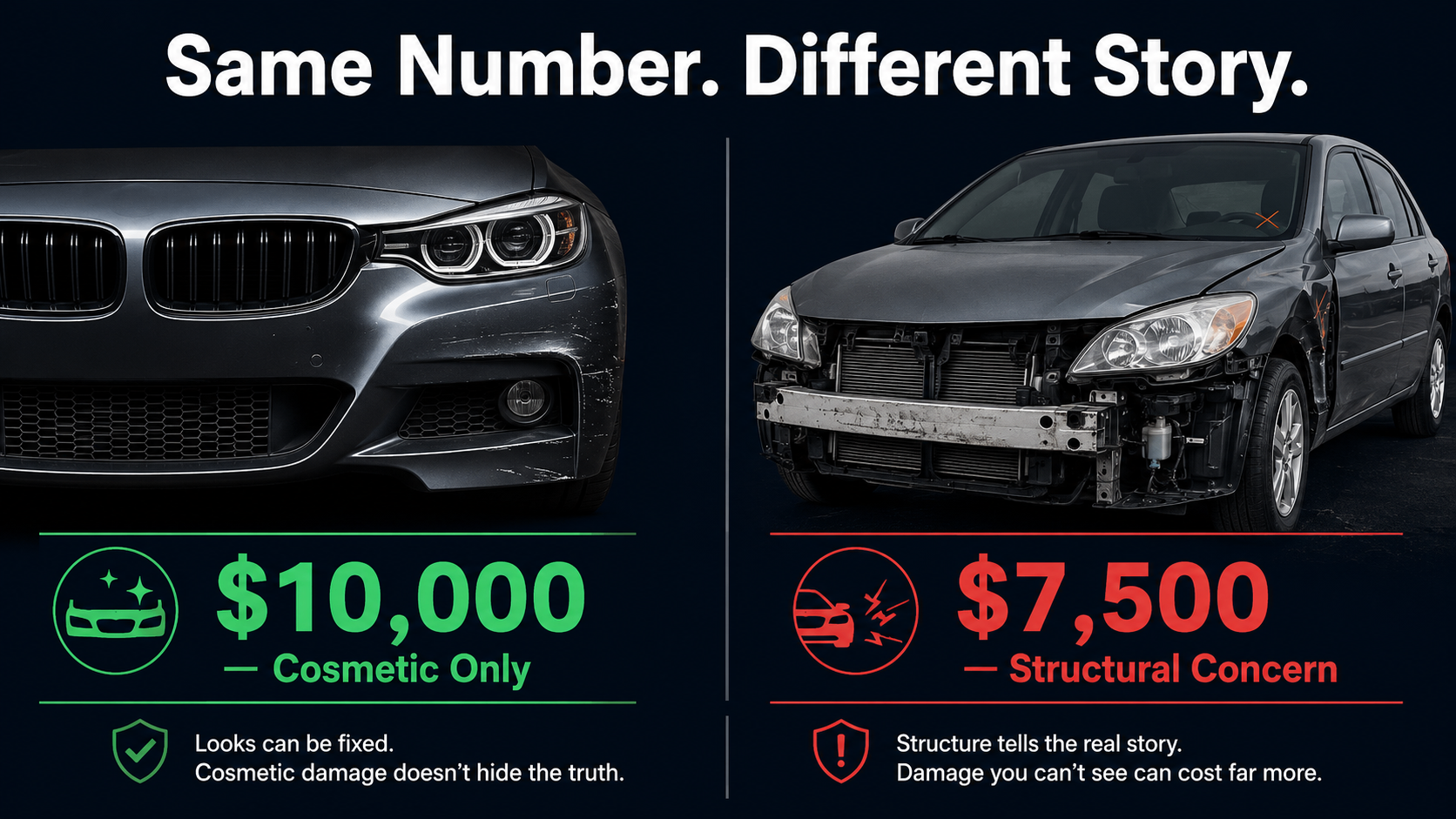
That is the entire claim. No structural damage. No airbag deployment. No frame involvement. No radiator. No cooling system. The vehicle sustained a front-end cosmetic impact — almost certainly a low-speed collision or parking incident — and the repair cost reached $10,000 because BMW M Sport headlight assemblies are among the most expensive replacement parts in the used car market.
Why the Dollar Amount on CARFAX Is Misleading Without Context
CARFAX Canada reports the total repair invoice amount declared to the insurance company or repair facility at the time of the claim. It does not categorize the claim by severity. It does not distinguish between a bumper replacement and a frame straightening. It does not tell you whether airbags deployed, whether the engine was involved, or whether the vehicle's structural integrity was compromised.
It reports a number. That number reflects parts cost, labour cost, paint cost, and facility overhead — all of which vary enormously by vehicle brand, trim level, and parts availability.
The Parts Cost Reality by Vehicle Category
| Repair Scenario | Japanese/Korean Economy Car | BMW/Mercedes/Audi (M/AMG/S-Line) |
|---|---|---|
| Single headlight replacement | $400–$900 CAD | $2,800–$3,800 CAD |
| Front bumper assembly + paint | $800–$1,400 CAD | $2,200–$3,500 CAD |
| Both headlights + bumper (cosmetic only) | $1,600–$3,200 CAD | $8,000–$11,000 CAD |
| Radiator + condenser + front clip | $3,500–$7,500 CAD | $12,000–$22,000+ CAD |
| Airbag deployment (front) | $4,000–$7,000 CAD | $9,000–$18,000 CAD |
The table above explains why the same dollar amount on CARFAX means completely different things depending on the vehicle. A $7,500 claim on a 2019 Honda Civic that involved radiator damage, front frame contact, and airbag deployment is a very different story from a $10,000 claim on a 2017 BMW 330i M Sport that involved two headlight assemblies and a bumper.
The Honda may have structural implications that affect long-term integrity. The BMW almost certainly does not — but its CARFAX number is higher.
The Two Types of Buyers This Creates
In my experience at the dealership, CARFAX claim amounts create a clear dividing line between two categories of used car buyers.
Buyers Who Have Owned European or Luxury Vehicles
Someone who has driven a BMW, Mercedes-Benz, Audi, or Range Rover and experienced a repair — or who has priced out parts for one — reads a $10,000 CARFAX claim on a luxury vehicle and immediately asks the follow-up question: what was actually replaced? They understand that the parts cost structure is fundamentally different. When I walk them through the repair details on the 330i — two headlights, one bumper, no structural involvement — they process it correctly. They see a vehicle that had a minor cosmetic incident and was properly repaired. They price it accordingly.
Buyers Who Have Only Owned Economy or Budget Vehicles
A buyer whose entire used car experience has been Toyota Corollas, Honda Civics, and Hyundai Elantras has a completely different mental model. On those vehicles, a $10,000 repair claim is a serious event. It likely involved significant mechanical or structural damage. When they see $10,000 on CARFAX for a BMW, they apply the same mental model — and they walk away from a vehicle that is, by any reasonable repair assessment, in sound condition.
What the $7,464 Average Discount Means in This Context
CARFAX Canada's June 2026 Used Vehicle Market Insights report shows that vehicles with a reported damage history sell at an average discount of $7,464 CAD below equivalent clean-title units. This discount is applied by the market broadly — it does not adjust for whether the damage was cosmetic or structural, and it does not adjust for the parts cost differential between vehicle categories.
What this means in practice: a 2017 BMW 330i M Sport with a cosmetic-only $10,000 headlight and bumper claim receives roughly the same market discount as a vehicle that sustained genuine structural damage. The market applies a blanket discount based on the existence of a claim, not its nature.
For buyers who read the details, this creates an opportunity. For sellers who understand what their vehicle actually sustained, this creates a pricing challenge — because the damage history discount is applied regardless of context.
How to Actually Read a CARFAX Canada Damage Report
The dollar amount is the last thing you should look at. Here is the sequence that matters:
Step 1 — Identify What Was Replaced
The parts list is the most important section of the damage report. Look specifically for:
- Airbag modules — deployment indicates a meaningful impact force. Airbag replacement also means the SRS system was triggered, which requires verification that the reset was completed properly.
- Frame or unibody components — any reference to frame rails, rocker panels, A-pillars, B-pillars, or floor pan indicates structural involvement. This is the category that genuinely affects long-term integrity.
- Radiator, condenser, or cooling system — front-end penetration deep enough to reach the cooling system indicates a more significant impact than a surface-level cosmetic repair.
- Steering or suspension components — subframe, control arms, or steering rack involvement suggests the impact transmitted force into the vehicle's drivetrain geometry.
Step 2 — Identify What Was NOT in the Repair
The absence of the above items from the parts list is meaningful. A claim that lists only exterior panels, headlight assemblies, bumper components, and associated paint — with no airbag, frame, cooling system, or suspension involvement — is a cosmetic repair regardless of the invoice total. The dollar amount becomes relevant only after you have confirmed what the money was actually spent on.
Step 3 — Cross-Reference With the Vehicle Platform
Apply the parts cost context for the specific vehicle. A $9,500 claim on a BMW M Sport is a cosmetic repair. A $9,500 claim on a Toyota RAV4 is a significantly more involved repair. The same dollar amount requires different interpretation depending on where it was spent.
Step 4 — Verify With an Independent Inspection
For any vehicle with a damage history — regardless of the repair assessment — a pre-purchase inspection from an independent licensed mechanic remains the definitive tool. The inspection will confirm whether the repair was completed to a quality standard, whether any secondary damage was missed, and whether the vehicle's structural geometry is within specification. No CARFAX report, however detailed, replaces a physical inspection.
The 2017 BMW 330i M Sport — What the Right Buyer Sees
Coming back to the vehicle that prompted this article: the 2017 BMW 330i M Sport with the $10,000 headlight and bumper claim.
A buyer who reads the parts list correctly sees a well-specified German performance sedan — M Sport package, sport-tuned suspension, upgraded brakes, M Sport steering wheel, sport seats — that sustained a cosmetic front-end impact, was properly repaired at a licensed facility, and is available at a meaningful discount below equivalent clean-title examples purely because of the CARFAX number.
A buyer who reads only the dollar amount sees a $10,000 accident and moves on.
The vehicle is the same. The repair is the same. The only difference is which part of the CARFAX report the buyer read first.
When the Dollar Amount Does Matter
This article is not an argument that CARFAX claim amounts are irrelevant. There are situations where the dollar figure itself is a meaningful signal — specifically when combined with the parts list to indicate severity.
- A claim above $15,000 CAD on an economy vehicle almost certainly involved structural or mechanical damage that goes beyond cosmetic repair.
- Multiple claims — even at lower amounts — indicate a pattern of incidents that may reflect how the vehicle was driven or maintained.
- Claims that include airbag deployment at any dollar amount warrant careful independent inspection of the SRS system reset documentation.
- Claims on vehicles older than 10 years that approach or exceed the vehicle's current market value raise questions about whether the repair was completed to the vehicle's actual pre-accident standard.
Key Takeaways
- The CARFAX damage claim dollar amount reflects parts cost, labour, and overhead — not repair severity. Context is everything.
- European luxury and performance vehicles (BMW, Mercedes-Benz, Audi, Jaguar, Range Rover) have fundamentally higher parts costs than Japanese, Korean, and domestic economy vehicles. The same dollar amount means different things on different platforms.
- A $10,000 BMW claim involving two headlights and a bumper is a cosmetic repair. A $7,500 economy car claim involving radiator and frame contact is a structural concern.
- Read the parts list first. Identify airbag, frame, cooling system, and suspension components. The dollar amount becomes meaningful only after you understand what it was spent on.
- The market applies a blanket $7,464 average discount to damaged-history vehicles regardless of repair nature. Cosmetic-only repairs on high-parts-cost vehicles are systematically undervalued by buyers who read dollar amounts instead of repair details.
- A pre-purchase inspection from an independent mechanic remains the definitive verification tool for any vehicle with a damage history.
- Use CARestify to check the vehicle's estimated market value both as a clean-title unit and with damage history factored in — so you understand the full discount picture before you negotiate.
CARFAX Canada June 2026 Used Vehicle Market Insights (average damage discount: $7,464 CAD) | Autostyle Auto Group dealership records, British Columbia | Canadian Black Book 2026 Market Preview | AutoTrader Canada — 2017 BMW 330i M Sport regional listing data, BC, July 2026
Carestify
Get Your Free Car Valuation Instantly
Quickly check your car's fair market value with our structured data inputs and AI-powered analysis tailored to the Canadian market.
Check My Car Value for Free