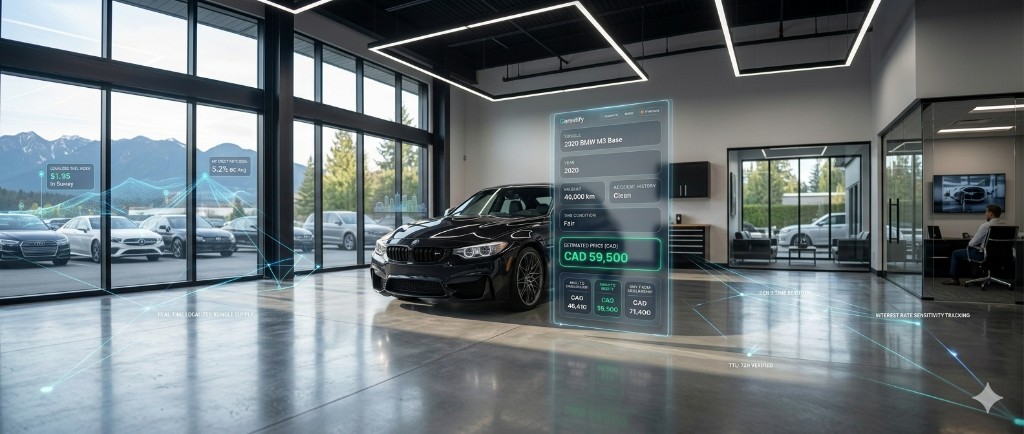
A dealer-informed, Canada-focused valuation workflow built for transparent pricing decisions.
01. What information does CAR:estify use?
The estimate starts with the vehicle you describe. CAR:estify uses the details available through the valuation workflow—not a complete live inventory of Canadian listings.
Vehicle identity: year, make, model, and trim, including packages that can change value (for example Sport-Tech or Touring).
Mileage: odometer information supplied in the workflow.
Geographic context: when you provide a postal code, we use the 3-digit Forward Sortation Area (FSA) as regional context—for example, SUV demand in the Rockies versus compact demand in urban Ontario.
Condition and history you supply: accident notes, tires, overall condition, mechanical notes, and service-history markers when you enter them. CAR:estify does not inspect the car or certify receipts.
02. How the valuation analysis works
Once those details are in the workflow, CAR:estify runs an AI-assisted, market-oriented analysis. The goal is a structured estimate for this vehicle—not a guaranteed live inventory feed.
Canadian market context: the analysis is built for Canadian used-car conversations. Available listing and pricing context may inform the estimate. That is not a guaranteed live inventory feed.
Depreciation and usage: year, kilometres, and condition information help place the vehicle relative to typical aging—not a claim that we have measured every sale of that model.
Transaction economics: a dealer buying a trade-in faces different costs than a private buyer or a retail lot. The estimate separates those contexts instead of pretending there is one true price.
03. What CAR:estify produces
You receive an AI-assisted vehicle valuation estimate with different pricing contexts. The report organizes those numbers and the vehicle details you provided. It is not a certified or official appraisal.
Dealership sale or trade: an estimate of selling or trading the vehicle to a dealer.
Private-party value: an estimate for a peer-to-peer sale.
Dealership retail: an estimate of the kind of asking range often seen when buying from a dealer.
Sample Preview (BMW M3 Report Snippet)
Sample report-style visual preview for output clarity.
04. How to use the result
Treat the report as structured decision support. Combine it with inspection, paperwork, and listings you can actually see.
At the dealer: use the dealership context as a reference while you review the actual offer, recon deductions, and the vehicle in front of you.
Private listing: use the private-party context as a starting range for Kijiji, Marketplace, or Autotrader—then adjust for photos, condition, and responses.
Avoid the generic average trap: a Canada-focused estimate can be more useful than a global average that ignores local context. It still does not guarantee a sale price.
How the Methodology Helps
Canada-focused market context
Generic valuation tools often treat Canada as a single, uniform market. CAR:estify is built to recognize that a low-mileage Toyota Camry in Vancouver can tell a different market story than one in Toronto. We combine vehicle details with Canadian market-oriented analysis to produce a structured estimate. The result is intended to help owners understand a reasonable market range—not replace a certified appraisal or guarantee a transaction price.
[Technical Process Diagram]
Mobile-optimized quick view of the full CAR:estify workflow.
Last updated: October 4, 2026 | Document Revision: v2.2.0