Carestify Press
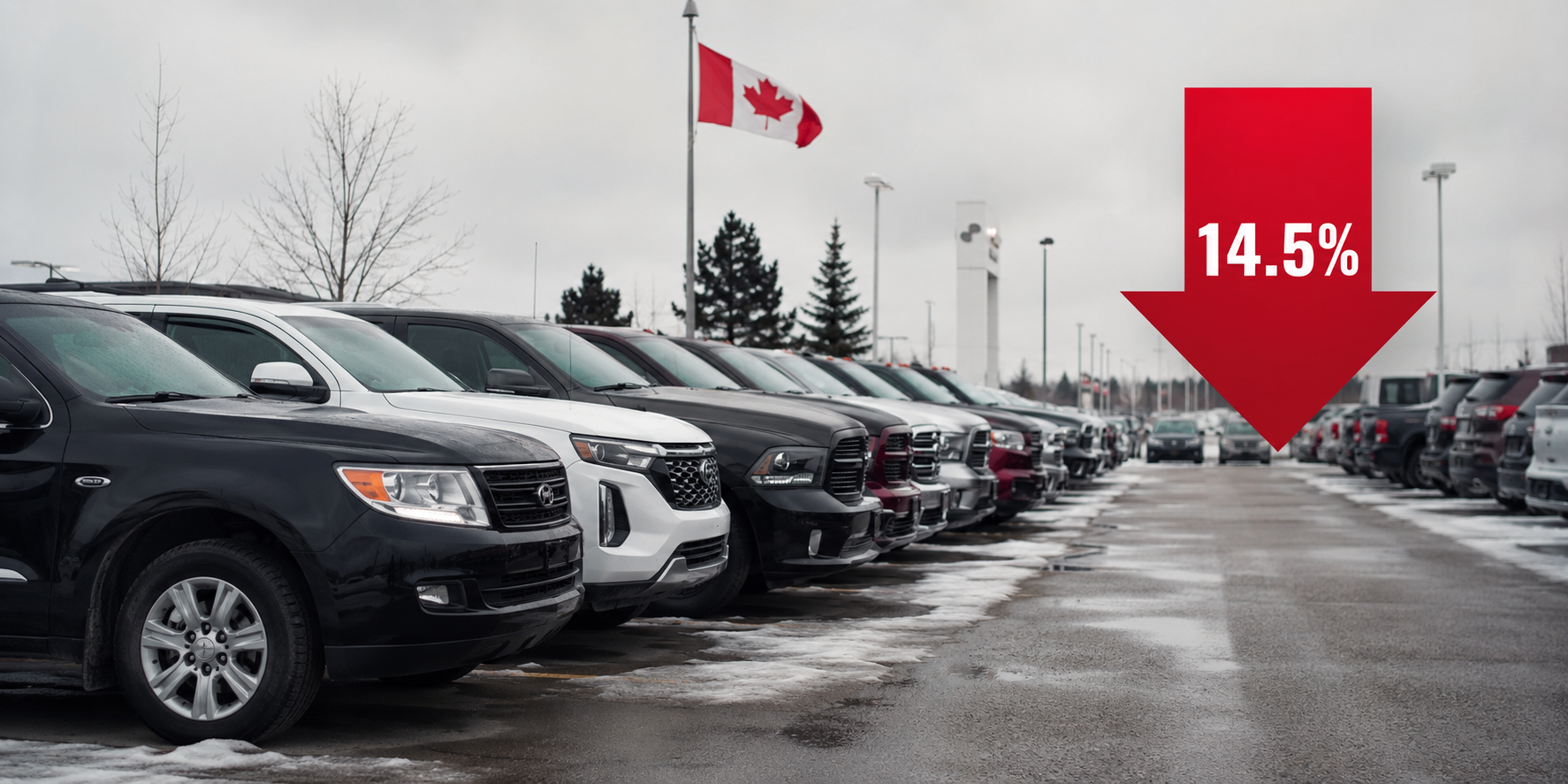
RSS Feed14.5%: What Canada's 2026 Used Vehicle Depreciation Rate Means for Owners and Buyers
July 1, 2026 · Noah Minami
14.5%: What Canada's 2026 Used Vehicle Depreciation Rate Means for Owners and Buyers
Canadian used vehicle market data analysts specializing in regional pricing trends and depreciation modeling. Data sources: Canadian Black Book 2026 Market Preview, CARFAX Canada June 2026 Market Insights
TL;DR: Canadian Black Book projects 14.5% depreciation on used vehicles in 2026 — returning to 2024 levels after a volatile 2025. Light trucks and SUVs face the steepest declines. Passenger cars follow a shallower curve. The steepest value loss is expected to occur before April. If you are planning to sell, the window to maximize equity is narrowing.
14.5%Projected 2026 depreciation
(CBB)
54.7%4-year retained value
(2022MY returning 2026)
$31,619National avg. listing price
April 2026 (CARFAX Canada)
2.6%Used supply decline
expected in 2026
Why 14.5% Matters — and Why 2026 Is Different
Depreciation is the single largest cost of vehicle ownership in Canada, yet most owners do not track it until the moment they attempt to sell or trade in. Canadian Black Book's 2026 Market Preview, published in February and based on the industry's most comprehensive vehicle valuation database, projects a 14.5% used vehicle depreciation rate for calendar year 2026. This figure applies to vehicles between two and six years old and reflects equipped retail price as the baseline.
To understand why this number matters, context is required. In 2024, Canada experienced a 15% depreciation correction — one of the steepest single-year value drops in the post-pandemic period. In 2025, the market reversed course. A combination of tariff-driven panic buying, artificial demand inflation, and price spikes of up to 12% during the March–June selling season temporarily suppressed depreciation well below its historical norm. That distortion is now unwinding.
"Depreciation is becoming more predictable, retention levels are normalizing, and volatility is easing. That said, performance continues to diverge sharply by segment, powertrain, and vehicle age." — Daniel Ross, Senior Manager of Industry Insights and Residual Value Strategy, Canadian Black Book
The 14.5% figure for 2026 represents a return to the correction trajectory that 2025 interrupted. The difference this time is that the steepest losses are expected in the first quarter, with values beginning to level off after April. For owners considering selling in 2026, this creates a specific and time-sensitive strategic window.
Which Segments Are Hit Hardest
The 14.5% headline figure is a market-wide average. Actual depreciation varies significantly by vehicle type, age, and powertrain. Canadian Black Book's segment-level projections reveal a clear divergence between light trucks and passenger cars — and within those categories, age and pricing history create additional splits.
Segment 2026 Depreciation Trend Key Driver Seller Outlook Light Trucks / Full-Size SUVs Above average decline Affordability ceiling reached; demand cooling Sell before Q2 peak season ends Compact Crossovers Accelerated depreciation Highest-demand segment, fastest days-to-turn Still liquid; best time to sell is now Passenger Cars (Sedan) Below average decline Already over-corrected in 2024–2025 Less urgent, but buyer pool shrinking Used Battery-Electric Vehicles Mixed — rising from lows Fuel prices + Chinese EV tariff impact pending Short-term recovery, long-term risk Domestically Built Full-Size Pickups Relative stability U.S. demand sustained due to origin advantage Strongest retention in the market
The most counterintuitive finding in CBB's data is that late-model vehicles (two to four years old) are depreciating faster than older units. Vehicles purchased during the 2020–2022 price spike are now correcting from artificially elevated baselines. A 2022 model year vehicle purchased at peak pricing has further to fall than a 2018 model purchased at pre-pandemic prices, even though the older vehicle has more accumulated mileage.
The 4-Year Retention Reality: 54.7%
Beyond the single-year depreciation rate, Canadian Black Book also publishes a 48-month retained value forecast. For 2022 model year vehicles returning to the secondary market in 2026, the projected 4-year retained value is 54.7% of original equipped retail price (ERT).
This means a vehicle purchased in 2022 at $45,000 CAD is expected to hold a market value of approximately $24,615 CAD when evaluated against current secondary market conditions. That $20,385 loss in four years represents the baseline equity erosion every owner in this cohort is absorbing — before accounting for financing costs, insurance, or maintenance.
Practical Example: A 2022 Honda CR-V purchased at $40,000 CAD with a 54.7% four-year retention rate carries a projected 2026 market value of approximately $21,880 CAD. If the vehicle carries a damage history, CARFAX Canada data shows an additional average discount of $7,464 — bringing the effective market value to approximately $14,416 CAD.
The CARFAX Canada Market Context: April 2026
CBB's projections are reinforced by CARFAX Canada's June 2026 Used Vehicle Market Insights report, which provides real-time transaction data through April 2026.
254,881 used vehicle transactions recorded in April 2026 — up 1.2% month-over-month, down 7.2% year-over-year
National average listing price: $31,619 CAD — up 0.8% from March, down 3.8% year-over-year
Used inventory rose 21.6% month-over-month in April as dealers prepared for summer selling season
30.9% of used vehicles listed for sale carried a reported damage history
Damaged vehicles averaged $7,464 below clean-title equivalents
Used EV average listing price: $40,893 CAD — up 4.7% month-over-month after declining since late 2025
The price plateau observed since February 2026 does not indicate stabilization in the long-term trajectory. It reflects a seasonal demand uptick ahead of the summer selling season. CBB's forecast expects the majority of 2026's depreciation to have occurred by April, with values beginning to level off in the second half of the year. This creates a specific implication for sellers: the best exit window for maximum equity extraction is the Q2 selling season (April through June), not autumn or winter.
What the Bank of Canada Rate Means for Your Car's Value
The Bank of Canada's decision to hold its key overnight rate at 2.25% as of June 2026 has a direct but often overlooked connection to used vehicle values. Higher borrowing costs reduce monthly payment affordability on financed vehicles, compressing the price ceiling buyers are willing to pay. At 2.25%, a $30,000 used vehicle financed over 60 months carries an estimated monthly payment of approximately $545–$575 CAD — a figure that continues to exclude many first-time or affordability-constrained buyers from the market.
The result is sustained downward pressure on transaction prices at the mid-market level ($25,000–$40,000 CAD), which is precisely where the majority of three-to-five-year-old SUVs and crossovers are currently priced. Sellers in this price band face the most competitive environment of the past three years.
The CUSMA Variable: An Unresolved Risk
The Canada–United States–Mexico Agreement (CUSMA) is currently under review, with renegotiation underway as of summer 2026. The outcome of this process will have material consequences for the used vehicle market in both directions.
A favourable outcome — removal of most U.S. tariffs on Canadian goods — would reduce input costs, improve consumer confidence, and potentially introduce additional used vehicle supply from cross-border trade channels. An unfavourable result would compound existing affordability pressures and extend the current depreciation cycle beyond 2026.
Canadian Black Book explicitly cites CUSMA as a primary source of ongoing market instability in its 2026 projection: "The level of risk continues to climb, and with it, the necessity to view conditions from a 360-degree perspective." This uncertainty is currently not priced into retail listing values, meaning a sudden trade policy shift could trigger rapid repricing in either direction.
Seller Strategy: Three Decisions Determined by This Data
1. Timing: Sell Before the Depreciation Curve Steepens Again
CBB projects the steepest value loss to occur before April, with a leveling-off in the second half of 2026. Sellers who act within the Q2 window (before June 30) are exiting at the optimal point on this year's depreciation curve. Waiting until autumn or early 2027 risks catching the next annual depreciation cycle before stabilization.
2. Documentation: Maintenance Records Are Now a Pricing Asset
In a market where 30.9% of listed vehicles carry a damage record and buyers are applying an average $7,464 discount to affected units, clean documentation is the single most controllable differentiator for sellers. A complete service history, verifiable through an OEM service portal or certified independent shop, directly counters buyer discount leverage.
3. Channel Selection: Private Sale vs. Dealer Trade-In
Dealer trade-in values are calculated against wholesale market rates, which CARFAX Canada and CBB both show declining faster than retail prices. Private sales yield an average 10–15% premium over trade-in offers for equivalent vehicles in the current market. In a 14.5% depreciation environment, the difference between a dealer trade-in and a private sale can represent $2,000–$5,000 CAD on a mid-market SUV.
Buyer Strategy: How to Use the Depreciation Rate to Your Advantage
Target the 2019–2021 Model Year Window
Vehicles from 2019 to 2021 have already absorbed the steepest post-pandemic correction. They are past the sharpest section of the depreciation curve, which means buyers acquire them at a discount without facing the same accelerated further depreciation that 2022–2024 models are currently experiencing. In a 14.5% environment, buying a vehicle that has already corrected is structurally better than buying one that is mid-correction.
Prioritize Clean-Title Units — The $7,464 Gap Is Real
The CARFAX Canada data point on damage-history pricing ($7,464 average discount) is often treated as a buyer opportunity. However, in a declining market, that discount does not protect buyers from further depreciation — it simply starts the clock lower. A damaged vehicle at $24,000 in a 14.5% depreciation market will be worth approximately $20,520 in 12 months, before accounting for any additional stigma from resale.
Request a CARestify Valuation Before Negotiating
Any negotiation that begins without an independent third-party valuation gives the opposing party an information advantage. The national average of $31,619 CAD is not your vehicle's value — it is the aggregate of 254,881 transactions across all makes, models, conditions, and regions. Your specific vehicle's value in your specific postal code area, at your specific mileage and condition, requires a structured analysis that accounts for regional variables like BC's 14.3% year-over-year price increase relative to the national baseline.
Key Takeaways
Canadian Black Book projects 14.5% used vehicle depreciation in 2026, returning to 2024 levels after 2025's tariff-driven distortion.
The steepest losses are concentrated in Q1 2026, with stabilization expected in the second half of the year.
Late-model vehicles (2022–2024 MY) face faster depreciation than older units, due to correction from artificially elevated purchase prices.
Domestically built full-size pickups show the strongest relative retention, driven by sustained U.S. demand.
The 4-year retained value for 2022 model year vehicles is projected at 54.7% of original equipped retail price.
CARFAX Canada April data confirms: 30.9% of listed vehicles carry damage history, with an average $7,464 discount applied.
CUSMA renegotiation outcome represents the single largest unresolved variable for H2 2026 market pricing.
Sellers maximize equity by acting within the Q2 2026 window and using private sale channels over dealer trade-in.
Data Sources:
Canadian Black Book 2026 Market Preview (February 2026 Publish) | CARFAX Canada June 2026 Used Vehicle Market Insights Report | Bank of Canada Overnight Rate — June 2026 (2.25%) | AutoTrader Canada Q1 2026 Price Index
Carestify
Get Your Free Car Valuation Instantly
Quickly check your car's fair market value with our structured data inputs and AI-powered analysis tailored to the Canadian market.
Check My Car Value for Free