Carestify Press
RSS FeedCanadian Used-Car Prices Are Softening: What the August 2026 Wholesale Market Means for Buyers and Sellers
August 25, 2026 · Noah Minami
TL;DR
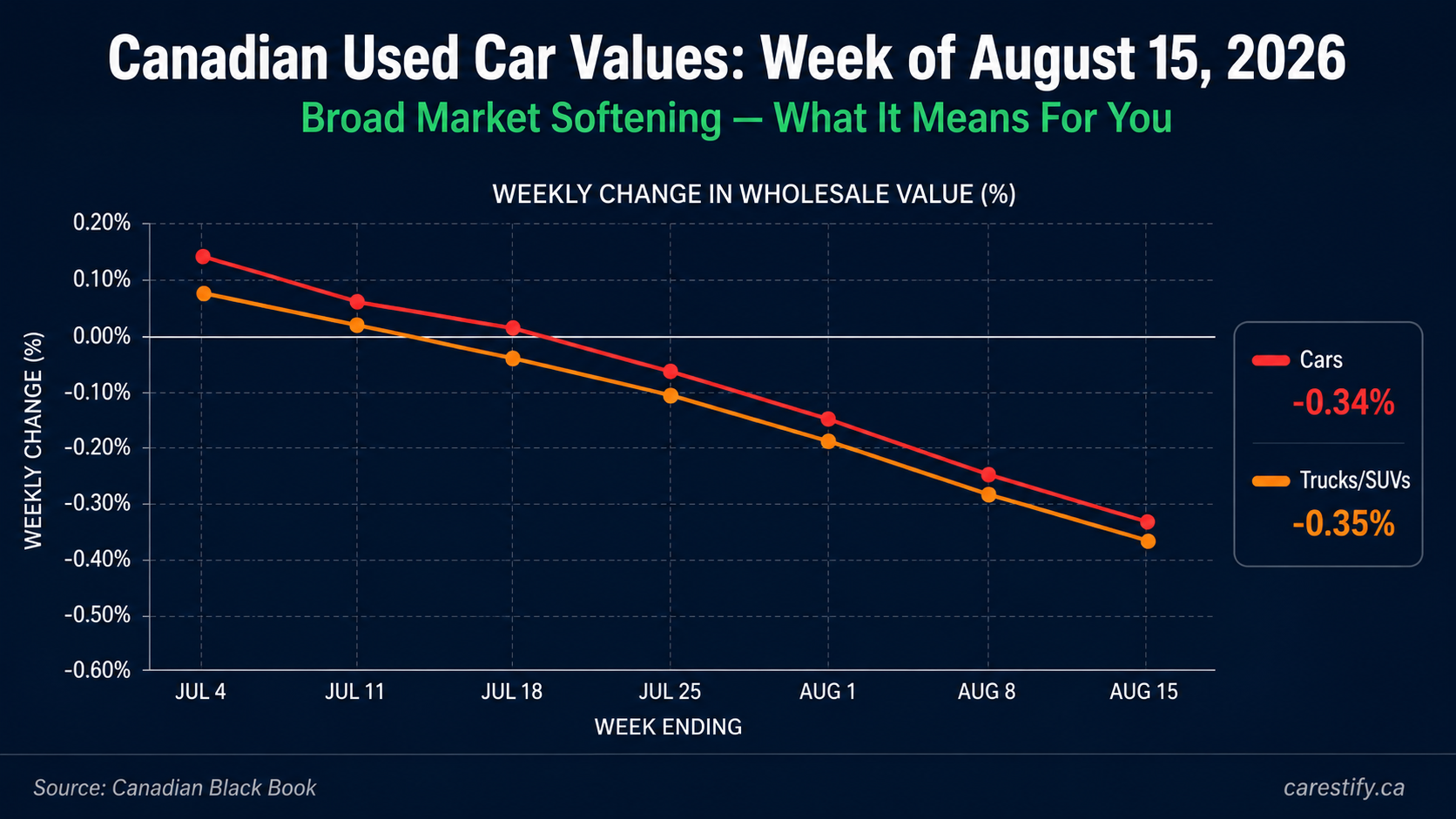
- Canadian Black Book reported that overall used-vehicle wholesale values declined 0.34% during the week ending August 15, 2026.
- Cars fell 0.34% and Trucks/SUVs fell 0.35%, meaning the softness was broad rather than isolated to one vehicle type.
- The decline was steeper than the 2017–2019 same-week average, but it does not mean every Canadian vehicle suddenly lost 0.34% of its value.
- Clean, desirable vehicles remain more resilient than average-condition inventory, which is important when estimating a real trade-in or private-sale price.
- Retail asking prices tend to react more slowly than wholesale values, so sellers should not use dealership advertisements alone to estimate what their own vehicle is worth today.
The Headline: Canadian Wholesale Values Fell Faster in Mid-August
Canadian used-vehicle prices continued to soften during the week ending August 15, 2026. According to Canadian Black Book's August 18 Market Insights report, overall wholesale values declined 0.34% for the week. Passenger-car segments also fell 0.34%, while Truck and SUV segments declined slightly more at 0.35%.
That weekly move is more significant when compared with the historical seasonal pattern. Canadian Black Book lists a 2017–2019 same-week average decline of 0.20% for the overall market. In other words, the latest market decline was approximately 0.14 percentage points steeper than that pre-pandemic benchmark. The prior week had declined only 0.19%.
| Canadian Wholesale Segment | Week Ending Aug. 15 | Prior Week | 2017–2019 Same-Week Average |
|---|---|---|---|
| Car Segments | -0.34% | -0.10% | -0.14% |
| Truck & SUV Segments | -0.35% | -0.26% | -0.27% |
| Overall Market | -0.34% | -0.19% | -0.20% |
The numbers point toward a market that is weakening more quickly than it did one week earlier, but the most important detail is not simply that prices are down. The decline is broad. Canadian Black Book reported that all nine car sub-segments moved lower during the week, the first time in six weeks that every reported car category declined together.
For consumers, however, a wholesale index should never be interpreted as a direct price tag. If the market falls 0.34% in one week, that does not automatically mean a vehicle worth $30,000 last Monday is exactly $102 cheaper today. The index measures aggregate wholesale-market movement across many vehicles. Individual valuation still depends heavily on model, trim, kilometres, accident history, condition, colour, options, location and current demand.
Wholesale Prices and Retail Asking Prices Are Not the Same Thing
One of the most common sources of confusion in used-car pricing is comparing a dealer's retail advertisement directly with a trade-in offer. Those numbers represent different stages of the vehicle market.
Wholesale Value
Wholesale is the dealer-to-dealer or auction layer of the market. It reflects what professional buyers may be willing to pay for inventory before retail preparation and before the vehicle reaches a consumer-facing lot. Auction fees, transportation, inspections and other acquisition costs may still sit on top of that wholesale number.
Dealer Trade-In Value
A dealership appraisal must account for the possibility that the car needs tires, brakes, glass, bodywork, mechanical repairs, detailing or other reconditioning. The dealer also carries market risk between the day the vehicle is purchased and the day it is eventually sold. When wholesale values are declining, that future-price risk becomes more relevant.
Private-Party Value
A private seller can often ask more than a dealer trade-in value because the seller does not need to build the same operating costs and retail margin into the transaction. However, a private seller also assumes the time, advertising, negotiation, payment and transaction risk personally.
Dealer Retail Value
Retail asking prices include considerably more than the dealer's acquisition price. A vehicle may have been inspected, repaired, detailed, transported, marketed and financed as part of a dealership's inventory operation. Asking price is also not necessarily the final transaction price.
Why the $37,900 Average Listing Price Does Not Mean Used Cars Are Worth $37,900
Canadian Black Book reported that the 14-day moving average listing price for used vehicles stood at approximately $37,900, based on roughly 169,000 vehicles advertised on Canadian dealership lots.
That is a useful measure of the retail market, but it can be misleading when applied to an individual vehicle. The average combines inexpensive compact cars with late-model SUVs, luxury vehicles, pickups, hybrids, EVs and many other categories. It is best viewed as a broad market indicator rather than a valuation tool.
There is another important difference: a listing price is an asking price. It does not tell us the exact transaction price, the amount offered on a trade, the dealership's cost basis or how long the vehicle has been advertised.
This is why retail listings tend to appear “sticky” when wholesale markets begin moving. Dealers do not necessarily reprice every vehicle on the lot the moment an auction index declines. Some vehicles were acquired earlier at higher costs. Others may still have strong local demand. Retail pricing may therefore lag behind changes visible in wholesale data.
The Market Is Falling, but Not Every Segment Is Falling
Another reason market averages need interpretation is that individual vehicle categories can move very differently from the headline index.
Canadian Black Book reported a 1.09% weekly decline for the Sub-Compact Crossover/SUV category and a 0.99% drop for Full-Size Luxury Crossovers/SUVs. Within passenger cars, Prestige Luxury Cars fell 0.63%, while Prestige Compact Cars declined 0.47%.
At the same time, Compact Vans moved in the opposite direction, rising 1.65% for the week. Sub-Compact Luxury Crossovers also recorded a small positive move of 0.16%.
That dispersion is exactly why a national headline cannot replace a vehicle-specific appraisal. A 2022 compact crossover, a five-year-old pickup and a luxury sedan can all be exposed to completely different inventory conditions at the same moment.
Vehicle configuration matters as well. An all-wheel-drive version may behave differently in British Columbia than a front-wheel-drive equivalent. A desirable trim with clean history and strong service records may remain attractive while average examples of the same model soften. Conversely, a vehicle with previous major damage or an undesirable configuration can depreciate much faster than its category.
What a 46.6% Auction Sale Rate Tells Us
Canadian Black Book reported auction sale rates ranging from 21.9% to 79.4% across monitored auction lanes, with an average of 46.6%.
The number requires some explanation. A vehicle appearing at auction does not automatically sell. Sellers commonly establish a minimum acceptable price, often called a floor. If bidding does not reach the level the seller wants, the unit may remain unsold.
An average conversion rate below 50% therefore does not necessarily mean buyers have disappeared. It can also indicate disagreement between what sellers want and what buyers believe inventory is worth. In a declining market, that gap can become especially noticeable because sellers may still be anchored to last month's pricing while professional buyers are bidding based on tomorrow's expected retail economics.
Canadian Black Book also noted that auction inventory increased slightly while upstream channels continued to receive priority access to some vehicles. Upstream remarketing allows inventory to be offered before reaching a traditional physical auction lane. That can affect both the quantity and quality of vehicles visible in open auction results.
For consumers, the practical lesson is that there is no single wholesale number. Dealers buying at auction are constantly making decisions based on vehicle quality, expected repair cost, transportation, local demand and potential resale time.
What This Means for Canadians Selling a Vehicle
Sellers should not panic because of one negative week. Used-car markets rarely move in a perfectly straight line, and seasonal depreciation is normal. But the August data does suggest that someone planning to sell within the next few months should not automatically assume waiting will produce a higher price.
In a softening wholesale environment, unrealistic asking prices become more dangerous. A private seller who starts several thousand dollars above a realistic market value may spend six or eight weeks reducing the price while the underlying market continues changing.
That does not mean accepting the first offer. It means establishing the right benchmark from the beginning. A seller should compare relevant vehicles with similar year, trim, kilometres, accident history and condition—not simply the same make and model.
BC sellers should also remember that regional demand matters. Weather, geography, fuel prices and consumer preferences can influence how quickly certain vehicles move. AWD crossovers, pickups, EVs and luxury vehicles do not necessarily behave the same way in Vancouver, the Interior or another Canadian province.
What This Means for Canadians Shopping for a Used Car
A falling wholesale market can eventually create better opportunities for buyers, but retail prices rarely reset overnight. Inventory already sitting on dealer lots may have been purchased at higher costs, and the most desirable vehicles can continue commanding strong prices even while market averages decline.
Buyers may gain more negotiating leverage on vehicles that are plentiful, less desirable or have been in inventory for an extended period. The opposite may be true for a clean, correctly priced vehicle in a configuration that dealers know they can sell quickly.
The August report therefore should not be interpreted as a signal to wait indefinitely for a market crash. A weekly decline of 0.34% is meaningful market information, but it is not evidence that every retail vehicle will suddenly become thousands of dollars cheaper.
A better strategy is to judge the individual deal. Compare the asking price with the vehicle's history, kilometres, condition and local alternatives. If a dealer's price already reflects the market and the vehicle is unusually clean, waiting for a theoretical future discount can result in losing the better car rather than getting the better deal.
A Simple Example: Why a Small Wholesale Decline Can Matter to a Dealer
Consider a hypothetical vehicle with an approximate wholesale value of $30,000. A 0.34% weekly market movement equals roughly $102 on that $30,000 amount. That calculation is only an illustration—it is not a prediction that the specific vehicle will lose exactly $102.
Now consider the dealer's exposure. The vehicle may need inspection, mechanical work, cosmetic reconditioning and detailing before being listed. It may then remain in inventory for several weeks. During that period, the dealer is also carrying capital and taking the risk that comparable vehicles become cheaper.
If the market continues falling, even relatively small weekly changes can influence the dealer's maximum purchase price. The effect becomes larger on more expensive inventory and more dangerous on vehicles with weak demand.
This is why consumers can sometimes see a dealer become more conservative on an appraisal even when similar retail advertisements have not changed much. The appraisal looks forward. The advertisement often reflects an inventory decision made in the past.
Why Condition May Matter More as the Market Softens
One of the more important observations in the Canadian Black Book report is that demand for high-quality vehicles remains strong even as overall wholesale prices decline.
This makes sense economically. When dealers become more selective, the inventory they are most willing to compete for is often the inventory requiring the least uncertainty. A clean vehicle with good history and predictable reconditioning is easier to retail than a similarly priced unit with substantial accident history, questionable maintenance or significant cosmetic work.
In a very strong market, scarcity can temporarily hide some of those differences because dealers need inventory. In a softer market, buyers can afford to be more selective. That may widen the value gap between excellent and mediocre examples of the same vehicle.
Consumers should keep this in mind when comparing prices. An unusually cheap vehicle is not automatically a bargain. It may have a rebuilt title, significant accident history, mechanical problems, unusual kilometres or another condition that the headline price does not explain.
The Bigger Signal CARestify Is Watching
One negative week is interesting. Several weeks of consistent behaviour are more important.
Canadian Black Book's August 18 report shows the overall market declining 0.34%, compared with a 0.19% decline one week earlier. Trucks and SUVs weakened from -0.26% to -0.35%, while passenger cars moved from -0.10% to -0.34%.
That acceleration is worth monitoring because wholesale markets generally react faster than consumer-facing retail prices. If wholesale values continue softening through late summer and early fall, we would expect pressure to appear gradually in trade-in appraisals, dealer acquisition bids and eventually retail asking prices.
On the other hand, continued demand for clean inventory could prevent that decline from being evenly distributed. In practical terms, Canada could experience a market where the average price declines while the best examples of desirable vehicles remain relatively expensive.
Key Takeaways
- Canadian wholesale used-vehicle values declined 0.34% during the week ending August 15, 2026.
- The decline was broader and faster than the prior week, affecting both passenger cars and Trucks/SUVs.
- The 0.34% market move should not be applied mechanically to every individual vehicle.
- Wholesale prices typically react faster than dealer retail asking prices.
- A $37,900 national average dealer listing price is a market indicator, not an estimate of what an individual vehicle is worth.
- Clean, desirable inventory can continue performing well even while the average market declines.
- Private sellers should price from realistic comparables rather than the highest dealership advertisement they can find.
- Trade-in values need to account for reconditioning, inventory time, market risk and dealership operating economics.
What Is Your Car Worth in Today's Canadian Market?
Market averages can tell you which direction used-car prices are moving, but an individual vehicle's value depends on its year, make, model, trim, kilometres, condition, accident history, options and local market demand.
CARestify helps Canadian vehicle owners estimate a more realistic market value using vehicle-specific information rather than relying on one national average.
Get My Free Estimate →Primary market data in this article is sourced from Canadian Black Book, Market Insights – 8/18/26, covering wholesale pricing for the week ending August 15, 2026.
Source: Canadian Black Book — Market Insights, August 18, 2026 .
Canadian Black Book is the source of the reported wholesale percentage movements, segment performance, auction sale rates, retail listing average and listing-volume figures referenced above. CARestify did not reproduce Canadian Black Book's charts or graphics.
The interpretation of those figures—including discussion of trade-in economics, retail-price lag, inventory risk, reconditioning, private-sale pricing and the implications for Canadian buyers and sellers—is CARestify analysis based on dealership valuation mechanics and real-world automotive retail experience.
Hypothetical calculations in this article are provided for educational illustration and are not confirmed vehicle transactions or guarantees of future market values. Vehicle values vary by location, specification, kilometres, history, condition and market demand.
Carestify
Get Your Free Car Valuation Instantly
Quickly check your car's fair market value with our structured data inputs and AI-powered analysis tailored to the Canadian market.
Check My Car Value for Free