Carestify Press
RSS FeedCan a Used Car Rebuild Your Credit Faster? A BC Dealer's Honest Guide for Post
July 17, 2026 · Noah Minami
prime auto financing in Canada
interest rate range (Canada)
on a $12,000 / 48-month loan
credit-rebuild vehicle strategy
What I See at the Dealership Since COVID
Since 2022, a pattern has emerged in the finance applications I process that did not exist before the pandemic. Buyers walk in — often with stable employment, often with reasonable income — and their credit application comes back with a score in the 580s or 620s. When I ask what happened, the answer is almost always the same: COVID. A lost job, a closed business, a deferred payment that became a missed one, a period where keeping the household running meant letting a credit obligation slide.
These are not irresponsible borrowers. They are people who were hit by something outside their control and are now trying to get back to where they were. Many of them have heard that a car loan is an effective way to rebuild credit. Some of them are right. Some of them are about to make it significantly worse.
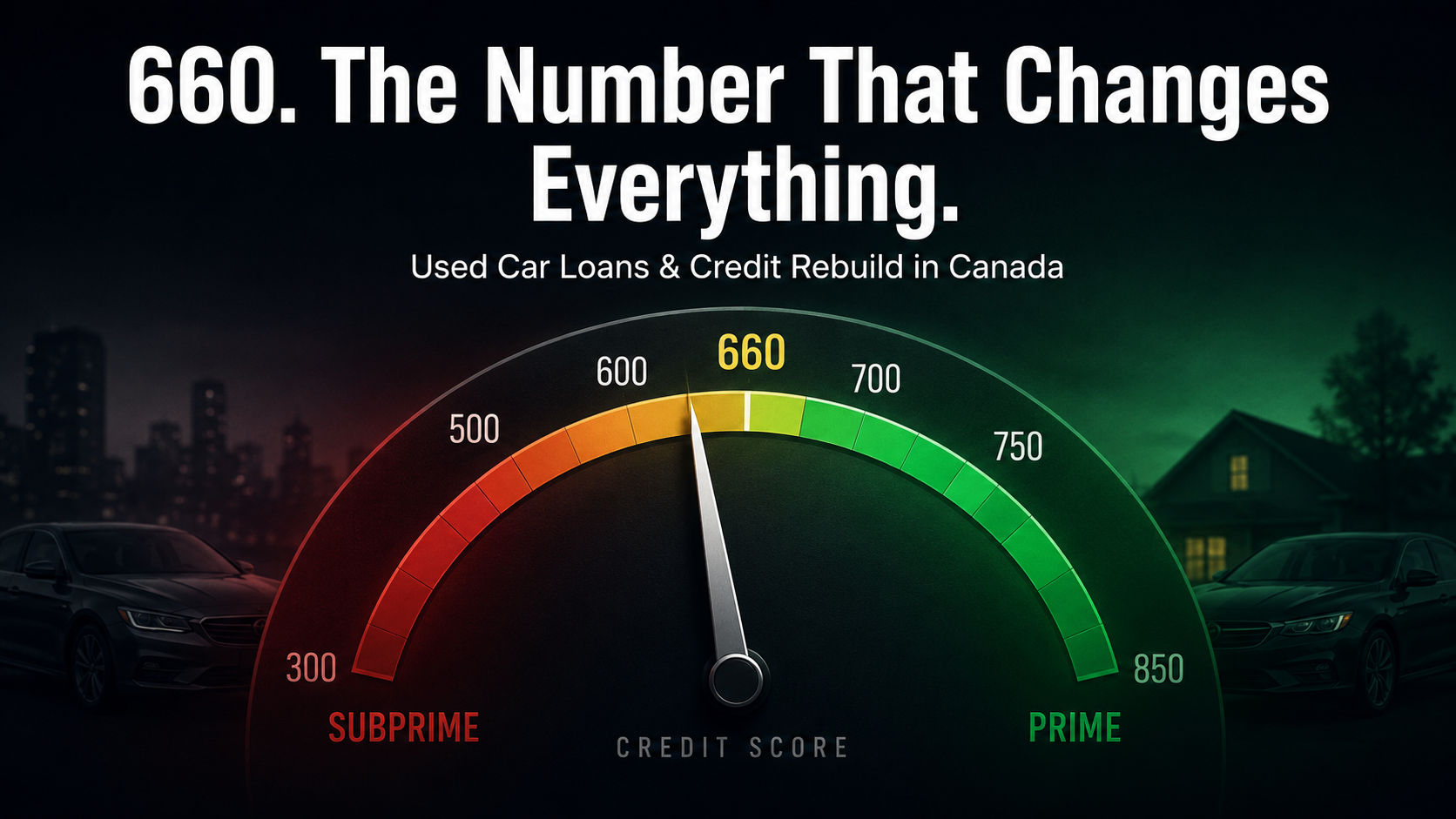
The Number That Changes Everything: 660
In Canada, 660 is the general threshold where prime auto financing becomes accessible. Above 660, standard lender rates apply — typically 6–10% depending on the vehicle, term, and lender. Below 660, most Canadian lenders classify the application as subprime, and subprime auto loan interest rates currently run from 10% to as high as 29.99%.
| Credit Score Range | Classification | Typical Rate Range | What This Means |
|---|---|---|---|
| 300–559 | Poor | 20–29.99% | Limited lenders, high down payment required, restricted vehicle age |
| 560–659 | Fair / Subprime | 10–19.99% | Subprime lenders available, meaningful interest cost over term |
| 660–719 | Near-Prime / Prime | 6–10% | Standard financing opens — most major lenders accessible |
| 720+ | Good to Excellent | 4–7% | Best available rates, maximum lender options, flexible terms |
This single number determines whether a credit-rebuilding car loan is a reasonable financial tool or an expensive mistake. Before committing to any financing strategy, you need to know exactly where your score sits — not approximately, but exactly.
The Credit Rebuild Car Loan: When It Actually Makes Sense
The logic is sound in principle. Auto loans are installment credit — fixed payments over a fixed term. Consistent on-time payments on installment credit are one of the most effective ways to improve a Canadian credit score over 12 to 24 months. The conditions that make this strategy work:
- Your credit score is at or approaching 660 — meaning prime or near-prime rates are accessible
- You have reportable income that lenders can verify (pay stubs, Notice of Assessment, or bank statements)
- The monthly payment fits comfortably within your actual budget — not stretched
- The vehicle is 2016 or newer in the $10,000–$14,000 CAD range — affordable, recent enough to be reliable
The Subprime Trap: When the Math Stops Working
Here is where many credit rebuild plans go wrong. If your score is below 660 and you finance a $12,000 vehicle at a subprime rate — 18.99% is common in this tier — the numbers look very different from the prime scenario.
| Scenario | Vehicle Price | Rate | Term | Total Interest Paid | Total Cost |
|---|---|---|---|---|---|
| Prime financing | $12,000 | 7% | 48 months | $1,820 | $13,820 |
| Subprime financing | $12,000 | 18.99% | 48 months | $5,290 | $17,290 |
| Difference | — | — | — | $3,470 more | $3,470 more |
You are paying $3,470 more for the same vehicle, the same loan term, and the same credit-rebuilding outcome — purely because your score was below 660 at the time of financing. The monthly payment difference is approximately $72 per month. Over 48 months, that difference compounds into a meaningful sum.
The question every subprime borrower needs to answer honestly before signing: Is improving my credit score worth $3,470 to me right now, in my specific situation?
Before New Financing: Check What Your Current Vehicle Is Worth
Many buyers I see in this situation are already carrying an existing auto loan — often with a high monthly payment that became difficult to manage post-COVID. Their instinct is to refinance into something with a lower payment. Before doing that, one number matters more than almost anything else:
What is your current vehicle worth versus what you still owe on it?
If you are currently financing a Toyota Camry, RAV4, Honda CR-V, Accord, or similar high-retention Japanese vehicle, there is a meaningful chance that the current market value of your vehicle equals or exceeds your remaining loan balance — particularly if you purchased pre-2023 and the vehicle has low to moderate mileage.
In this case, selling the vehicle to a dealer can:
- Pay off the existing loan entirely
- Generate cash equity toward a less expensive replacement vehicle
- Eliminate the high monthly payment straining your budget
- Allow you to start fresh with a lower-cost vehicle and a manageable prime-rate payment
Three Questions to Answer Before You Sign Anything
Question 1 — What is your current vehicle worth vs. what do you owe?
Get an independent market valuation of your current vehicle and compare it to your loan payoff amount. If the vehicle is worth more than you owe, selling it to a dealer may be your best first move — before taking on any new financing. Use CARestify to get a current market estimate before any dealer conversation.
Question 2 — Is your credit score at or above 660, with reportable income?
If yes — prime financing is accessible and a well-structured used car loan is a legitimate credit-rebuilding tool. If no — you are in subprime territory. Calculate the total interest cost of the proposed loan before committing. That total interest figure is the real price of your credit improvement. Decide whether it is worth paying.
Question 3 — If subprime is unavoidable, does the improvement justify the cost in your situation?
This is a personal financial question. If you have a mortgage application, business financing, or another major credit event planned within 24 months, the subprime interest cost may be a reasonable investment. If your life does not require an excellent credit score in the near term, lower-cost alternatives — secured credit card, credit builder loan, reducing revolving balances — may produce similar improvement at a fraction of the cost.
Pre-Decision Checklist
| Check | What to Verify |
|---|---|
| ☐ Loan balance vs. market value | Get an independent valuation. If positive equity exists, explore selling before refinancing. |
| ☐ Credit score — above or below 660? | Check Equifax or TransUnion directly. This number determines your available rate tier. |
| ☐ Reportable income | Canadian lenders require documented income. Self-employment must be substantiated with Notice of Assessment or bank statements. |
| ☐ Total interest cost if subprime | Calculate principal + total interest over the full term. That total is your credit rebuilding price tag. |
| ☐ Do you actually need a high score soon? | Mortgage or major financing within 24 months? If yes, the cost may be justified. If no, consider lower-cost alternatives first. |
Lower-Cost Alternatives Worth Considering
A car loan is not the only way to rebuild credit in Canada. For buyers whose current vehicle situation is manageable, lower-cost alternatives include:
- Secured credit card — a $500–$1,000 deposit secures a card that reports monthly to Equifax and TransUnion. Low cost, effective for score improvement over 12–18 months.
- Credit builder loan — offered by some Canadian credit unions, these small installment loans are designed specifically for credit rehabilitation with lower rates than subprime auto financing.
- Reducing revolving credit utilization — lowering your balance below 30% of your credit limit can produce meaningful score improvement within 60–90 days at zero additional cost.
None of these require taking on thousands of dollars in high-interest debt. For buyers who need a vehicle and want to rebuild credit simultaneously, a well-structured used car loan remains a viable tool — but only when the numbers justify it.
Key Takeaways
- Post-COVID credit damage is common in Canada. A used car loan can be a legitimate credit-rebuilding tool — but only under the right conditions.
- 660 is the prime financing threshold. Below this score, subprime rates of 10–29.99% apply. On a $12,000 vehicle over 48 months, this can mean $3,470 in extra interest versus a prime-rate loan.
- Before taking on new financing, check whether your current vehicle has positive equity. Selling a Toyota or Honda with strong residual value may provide a cleaner financial reset than refinancing.
- Calculate the total interest cost of any subprime loan. That number is the real price of your credit improvement. Decide deliberately whether it is worth paying.
- Most Canadians do not need an excellent credit score for daily life unless a mortgage or major credit event is planned within 24 months.
- Lower-cost alternatives — secured credit cards, credit builder loans, reducing revolving balances — can produce meaningful score improvement without high-interest debt.
Know What Your Current Vehicle Is Worth Before You Decide
If you are considering trading in or selling your current vehicle as part of a credit rebuild strategy, get an independent market estimate first. Knowing your equity position changes every conversation you have with a dealer.
Get My Free Estimate →Equifax Canada — Credit Score Range Guidelines | TransUnion Canada — Credit Score Tier Definitions | Direct dealership finance experience — Autoteque Auto Group, BC, 2024–2026 | Canadian Black Book 2026 Market Preview | CARFAX Canada June 2026 Used Vehicle Market Insights
Carestify
Get Your Free Car Valuation Instantly
Quickly check your car's fair market value with our structured data inputs and AI-powered analysis tailored to the Canadian market.
Check My Car Value for Free