Carestify Press
RSS FeedCheap or Good? The Truth About Used Car Prices Dealers Don't Always Explain
July 28, 2026 · Noah Minami
is only one cost
come after acquisition
retail positioning
Price or Condition
The Price You See Is Not the Dealer's Profit
One of the most common misunderstandings in the used car business is the idea that a dealer simply buys a vehicle for $20,000, puts a $5,000 margin on it, and sells it for $25,000.
That is not how the business works.
The purchase price is only the beginning. Once a dealer acquires a vehicle, there are additional costs before that vehicle can be responsibly offered to a retail customer. The vehicle may need a mechanical inspection, oil service, brakes, tires, detailing, repairs, safety-related work, transportation, certification, advertising and other preparation.
There is also the cost of keeping the vehicle in inventory. Every day a vehicle sits on a lot represents capital tied up in that unit. The dealer also carries the risk that something unexpected will be discovered after purchase or that the market will move before the vehicle sells.
The actual calculation is much closer to: Acquisition cost + inspection + reconditioning + transportation + inventory cost + operating costs + market risk + required profit = retail price.
Dealers Have to Study the Market Too
Another part of dealer pricing that buyers often do not see is the amount of market research that happens before a vehicle gets a price tag.
A dealer does not simply decide that a vehicle is worth a certain number because they personally like it. We look at competing vehicles currently listed in the market, mileage, trim level, condition, accident history, equipment, model year, location and how aggressively similar vehicles are priced.
If there are ten comparable vehicles for sale, pricing a vehicle significantly above the competition may mean it sits for weeks or months. Pricing it too low may create a quick sale but leave money on the table. The objective is to find a price that is reasonable for the current market while accounting for the actual condition and cost of the vehicle.
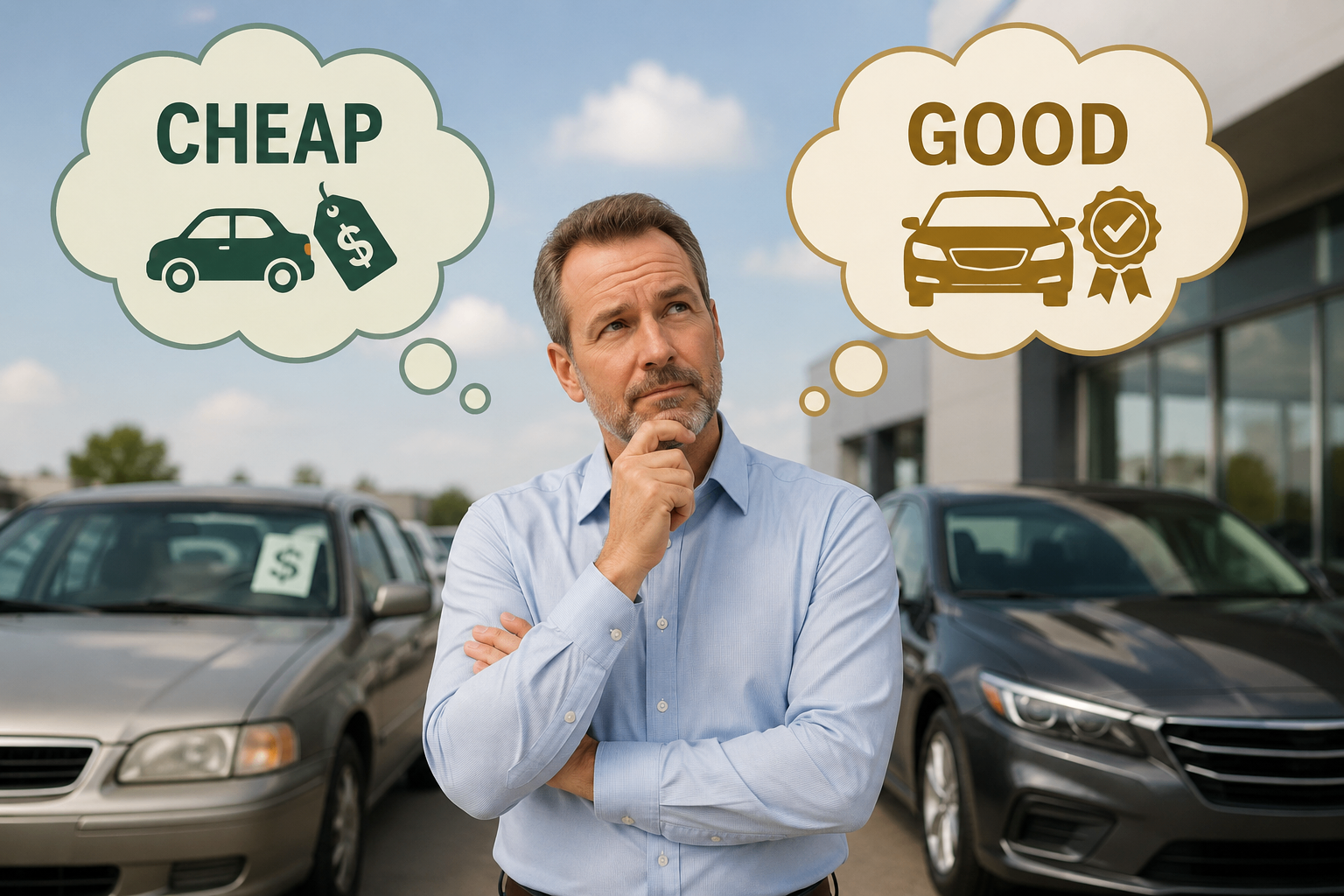
There Is No Such Thing as Cheap and Good — Usually
This is probably the part of the used car market that buyers do not want to hear.
In most cases, you have two choices: cheap or good.
A cheap vehicle can absolutely exist. But there is usually a reason why it is cheap. It may have higher mileage, accident history, deferred maintenance, worn tires, mechanical issues, cosmetic damage, poor service history or simply weaker demand.
A good vehicle can also exist. A clean example with strong maintenance history, good condition, reasonable mileage and desirable specifications will generally command a stronger price.
What buyers often want is the third option: a very good vehicle at a price significantly below what the market says it is worth.
That is where reality usually gets in the way.
❌ The "Cheap AND Good" Problem
```If a vehicle is genuinely clean, mechanically sound, properly maintained and competitively priced, the dealer has little reason to sell it substantially below market value.
If the dealer cannot achieve a reasonable retail return at the requested price, there is another option available: wholesale.
A dealer does not have to give away a good vehicle simply because a buyer wants to purchase it below market. If the retail opportunity disappears, the vehicle can be sold through wholesale channels and the dealer can still take a smaller, controlled profit rather than accepting an unreasonable retail deal.
```Why Lowballing a Good Used Car Usually Doesn't Work
There is nothing wrong with negotiating on a used vehicle. Negotiation is part of buying a car.
The problem starts when the negotiation is based on an unrealistic number and the buyer keeps adding new reasons to justify it.
A buyer may start with a low offer and then point to a small scratch, a tire that is not brand new, a competing listing in another city, an unrelated vehicle that sold for less, or a minor cosmetic issue as justification for another reduction.
If the vehicle is already reasonably priced against the market, this approach rarely produces the result the buyer wants.
``` ```| Buyer Approach | What the Dealer Sees | Likely Result |
|---|---|---|
| Reasonable market-based offer | Serious negotiation | Deal may be possible |
| Moderate negotiation based on real issues | Something worth discussing | Possible adjustment |
| Large lowball below market | Vehicle is not being valued realistically | Dealer may decline |
| Repeated lowball + multiple excuses | Deal is unlikely to make sense | Time wasted for both sides |
| Good vehicle demanded at wholesale-level pricing | Retail sale no longer makes economic sense | Dealer can choose wholesale instead |
A Good Dealer Does Not Need to Sell Every Car to You
This is another reality of the business that buyers sometimes misunderstand.
A dealer's goal is not simply to sell every vehicle to the next person who walks through the door at any price.
The goal is to sell the vehicle at a price that makes sense based on its acquisition cost, preparation costs, market position and risk.
If a buyer offers a number that does not make economic sense, the dealer has a choice. They can decline the deal, continue marketing the vehicle to retail buyers, adjust the price later if market conditions change, or move the vehicle through wholesale.
So What Should You Prioritize When Buying a Used Car?
Before shopping for a used vehicle, make one decision first:
Are you going to prioritize price, or are you going to prioritize condition?
Neither choice is automatically wrong. The right answer depends on your knowledge, your budget and your ability to deal with problems after the purchase.
✅ Option 1 — Prioritize Condition
```This is the safer approach for buyers who do not have much mechanical knowledge.
If you cannot confidently identify mechanical problems, understand maintenance records or estimate the cost of repairs, buying the cheapest vehicle available can become expensive very quickly.
In that situation, paying more for a vehicle that is in genuinely good condition can make more sense than saving money on the purchase price and discovering several thousand dollars in repairs afterward.
If you do not know cars well, condition should usually come first.
```⚡ Option 2 — Prioritize Price
```This approach can make sense for buyers who understand vehicles well and have access to a trusted mechanic or repair shop.
If you know what you are looking at, you may be able to purchase a vehicle with cosmetic problems, deferred maintenance or other manageable issues at a lower price.
The important difference is that you understand what you are buying and know what the repairs will actually cost.
A cheap car can become a good deal if you have the knowledge, tools and repair network to make it one. Without those advantages, the same vehicle can become an expensive mistake.
```Price vs. Condition: Which Buyer Are You?
``` ```| Priority | Best For | What You Need | Main Risk |
|---|---|---|---|
| Condition First | Buyers with limited mechanical knowledge | Budget for a properly maintained vehicle | Higher purchase price |
| Price First | Experienced vehicle buyers | Mechanical knowledge + trusted shop | Unexpected repair costs |
| Lowest Possible Price | Almost nobody | Very high tolerance for risk | The cheapest car may become the most expensive |
| Good Condition + Fair Market Price | Most everyday buyers | Understand market value | Usually the most balanced approach |
The Cheapest Car Is Not Always the Cheapest Car to Own
This is where the purchase price can become misleading.
Imagine two vehicles that are both listed for sale. One costs $16,000 and the other costs $20,000.
At first glance, the $16,000 vehicle looks like the better deal.
But suppose the cheaper vehicle needs $2,500 in immediate mechanical work, $1,200 in tires and brakes, and additional maintenance that the more expensive vehicle has already received.
The $16,000 vehicle is no longer a $16,000 vehicle in practical terms.
The better question is not always "Which car is cheaper?" It is "Which car gives me the better total value after I account for condition, maintenance and expected repair costs?"
This is exactly why comparing two vehicles only by their listing price can be misleading.
What You Should Actually Negotiate
If you want to negotiate with a dealer, do it based on facts.
Check the vehicle's market position. Compare similar vehicles with similar mileage, trim, accident history and condition. Look at the actual differences between the cars rather than simply finding the cheapest listing you can find anywhere in Canada.
If you discover a legitimate issue that has not already been reflected in the asking price, bring it up. That is a reasonable negotiation.
What usually does not work is taking a properly priced vehicle and attempting to push the price dramatically lower simply because you want a better deal.
The Dealer's Perspective Is Simple
Dealers are in the business of buying and selling vehicles. We understand that customers want the lowest possible price. That is normal.
But the dealer also has no reason to give away a good vehicle below a reasonable market value.
If the retail price does not work, wholesale is always another option. The dealer may make a smaller profit, but the transaction can still make economic sense without spending hours negotiating over a number that does not reflect the vehicle's value.
Before You Buy: Ask Yourself These Three Questions
- Do I know enough about cars to identify potential mechanical problems?
- Do I have a trusted mechanic who can inspect and repair the vehicle at a reasonable cost?
- Am I comparing the vehicle's actual market value, or am I simply trying to buy it as cheaply as possible?
Your answers will tell you whether you should focus primarily on condition or price.
If you do not have mechanical knowledge or a trusted repair shop, paying a fair price for a genuinely good vehicle can be the smarter financial decision.
If you have strong mechanical knowledge and a reliable shop, you may be able to take advantage of vehicles that other buyers avoid because of manageable repairs or cosmetic issues.
Key Takeaways
- A dealer's retail price is not simply the purchase price plus a profit margin. ```
- Inspection, reconditioning, transportation, inventory costs, operating expenses and market risk all contribute to the final retail price.
- Dealers spend significant time studying competing listings and current market conditions before setting a reasonable price.
- In the used car market, cheap and good rarely come together. There are cheap vehicles and there are good vehicles.
- A clean, properly maintained vehicle that is already priced reasonably against the market gives a dealer little reason to accept a major lowball offer.
- Repeatedly lowballing a good vehicle and adding new reasons to reduce the price usually wastes time for both the buyer and dealer.
- If a retail deal no longer makes economic sense, a dealer may choose to sell the vehicle through wholesale instead.
- When buying a used vehicle, decide first whether price or condition matters more to you.
- If you do not understand cars well, prioritizing condition is generally the safer approach.
- If you have mechanical knowledge and access to a trusted, affordable mechanic, prioritizing price can make more sense.
- The cheapest vehicle is not necessarily the cheapest vehicle to own. Purchase price and total ownership cost are not the same thing. ```
Know the Market Value Before You Negotiate
```Before making an offer on a used vehicle, understand what the vehicle is actually worth in the current market. A realistic market value gives you a stronger negotiating position and helps you distinguish a genuinely overpriced vehicle from a properly priced one.
Check My Vehicle's Value → ```This article reflects direct dealership experience and explains the practical economics behind used vehicle pricing and negotiation. Individual dealer costs, vehicle condition, market demand and pricing strategies can vary by vehicle and transaction.
Carestify
Get Your Free Car Valuation Instantly
Quickly check your car's fair market value with our structured data inputs and AI-powered analysis tailored to the Canadian market.
Check My Car Value for Free