Carestify Press
RSS FeedLease Buyout Equity in Canada: How to Pocket Up to $4,000 When Returning Your Leased Vehicle
July 15, 2026 · Noah Minami
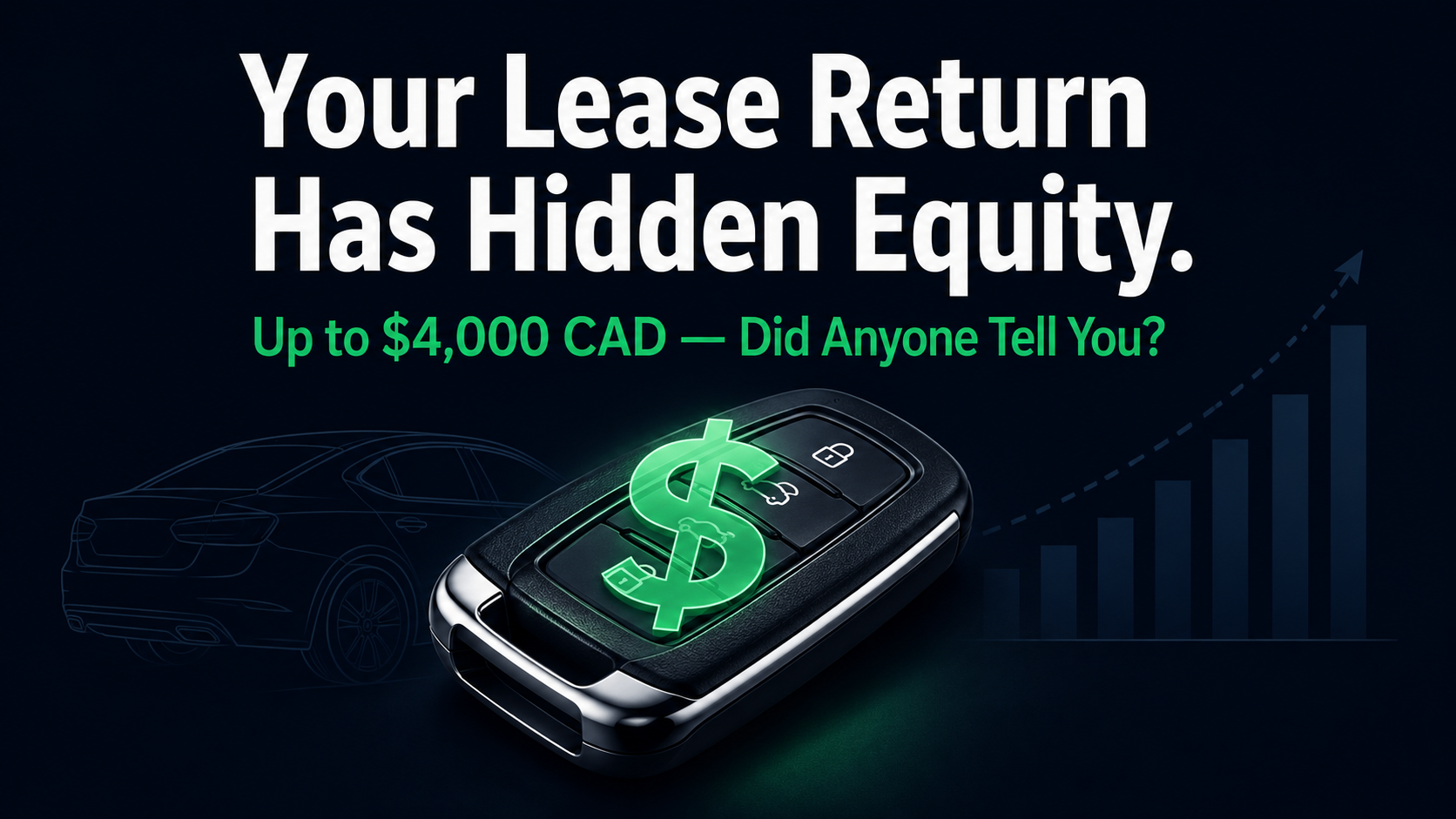
receive at lease return (CAD)
depreciation rate (CBB)
third-party buyouts in Canada
avg. listing price (CARFAX)
What Lease Equity Is — and Why Most Lessees Miss It
When you lease a vehicle, the finance company calculates a residual value — the predicted worth of the vehicle at lease-end. That residual determines your buyout price: the amount you would pay to purchase the vehicle outright when the lease expires.
The problem is that residual values are set two to four years in advance, based on depreciation projections at the time of signing. When market conditions shift — as they did dramatically during the 2020–2023 supply shortage and again with the 2026 used vehicle market correction — the actual market value of the vehicle at lease-end can differ significantly from what the finance company predicted.
When the current market value is higher than the residual buyout price, the difference is equity. It belongs, in principle, to the lessee — but only if they know how to access it.
The Franchise Dealer Equity Program: How It Actually Works
Franchise dealerships — authorized dealers for a specific brand — have a structural incentive to acquire certified pre-owned inventory of their own brand. A Toyota dealer wants used Toyotas. A Honda dealer wants used Hondas. Used inventory from lease returns is the cleanest possible source: known service history, known mileage, single owner, and often still within powertrain warranty coverage.
To secure this inventory, some franchise dealers run structured equity programs at lease-end. Instead of simply accepting the vehicle return and pocketing the market-versus-residual spread themselves, they offer the lessee a portion of that equity as an incentive to return the vehicle to their specific dealership and, ideally, to lease or purchase a new vehicle from the same brand.
How to Access the Equity Program
- Contact your brand's franchise dealer 60 to 90 days before lease-end — not on the day of return.
- Ask specifically whether a lease loyalty or equity program is currently active for your vehicle.
- Get an independent market valuation of your vehicle first — so you know the actual equity position before entering any negotiation.
- Compare the dealer's equity offer against the actual market spread. The dealer will not offer you the full difference — their offer will reflect their own margin — but it should be a meaningful portion.
- If you are not purchasing or leasing a new vehicle from the same brand, the equity program may still apply as a cash payment or credit — ask explicitly.
Independent Dealers and the Equity Opportunity
Franchise dealers are not the only ones who can execute a lease buyout. In Canada, independent dealers with the right lender relationships can also facilitate a third-party lease buyout — purchasing the vehicle directly from the finance company at the residual price on behalf of the lessee, then either reselling it or passing equity back to the lessee as part of the transaction.
Well-connected independent dealers — particularly those with established relationships with franchise dealer networks — can facilitate these transactions efficiently. The lessee benefits from having more options and, in competitive situations, potentially better equity offers than the single franchise dealer would provide.
The Brands That Blocked Third-Party Buyouts — And Why
This is where the landscape changed significantly in 2025 and 2026, and where today's direct experience comes in.
I attempted to facilitate a Lexus lease buyout for a client today. The transaction was straightforward — the vehicle's market value exceeded the residual, the client wanted to access their equity, and I had the lender relationships to execute the buyout. The transaction did not go through. Lexus Financial Services Canada has restricted third-party lease buyouts, meaning the buyout can only be completed by the lessee directly or through an authorized Lexus franchise dealer. Independent dealers are locked out.
This is not unique to Lexus. Mercedes-Benz Financial Services Canada operates the same restriction. These brands have made a deliberate policy decision to keep their lease-end vehicles within their own franchise networks — and to prevent independent dealers from accessing the equity spread that exists when market values exceed residuals.
| Brand | Third-Party Buyout | Equity Program at Franchise | Notes |
|---|---|---|---|
| Toyota / TFS | Generally available | Yes — loyalty programs active | Check with dealer 60–90 days before end |
| Honda / AHFC | Generally available | Yes — equity programs exist | Varies by region and current inventory need |
| Lexus Financial Services | Blocked — recently restricted | Franchise only | Third-party buyout no longer permitted as of 2025–2026 |
| Mercedes-Benz Financial | Blocked | Franchise only | Long-standing restriction; tightened further recently |
| BMW Financial Services | Restricted in some cases | Equity programs available | Verify with BMW dealer — varies by program |
| Ford / FMC | Generally available | Equity programs active | F-150 and Bronco leases particularly active |
| GM / GMAC | Generally available | Active programs | Silverado and SUV leases often have meaningful equity |
| Hyundai / Kia | Generally available | Equity programs exist | EV lease returns increasingly active in this category |
Why Lexus and Mercedes-Benz Made This Move
The decision to block third-party buyouts is not arbitrary. Both Lexus and Mercedes-Benz are premium brands with certified pre-owned programs that depend on a steady supply of low-mileage, single-owner, dealer-maintained lease returns. These vehicles are the foundation of their CPO business — and CPO generates significant margin for franchise dealers.
When market values exceeded residuals significantly — as happened during the 2021–2023 period — independent dealers aggressively pursued lease buyouts, acquiring premium brand vehicles at below-market residual prices and removing them from the franchise network's CPO pipeline. Both Lexus and Mercedes-Benz responded by restricting buyout rights to protect their franchise dealers' inventory access.
From the lessee's perspective, this restriction means one thing: if you lease a Lexus or Mercedes-Benz, your equity options at lease-end are limited to what your franchise dealer offers you. You cannot shop that equity to an independent dealer for a competing offer. The franchise holds the negotiating advantage.
What Lessees Should Do Right Now
Step 1 — Know Your Equity Position Before Lease-End
Get an independent market valuation of your vehicle 90 days before your lease end date. Compare this against your lease-end buyout price, which is on your original lease agreement. The difference, if positive, is your equity. This number is your negotiating foundation for any conversation with a franchise dealer.
Step 2 — Check Your Brand's Third-Party Buyout Status
If you lease a Toyota, Honda, Ford, GM, Hyundai, or Kia — contact an independent dealer with strong lender relationships to explore whether a third-party buyout makes sense for your situation. Competition between your franchise dealer and an independent dealer can improve your equity offer.
If you lease a Lexus or Mercedes-Benz — go directly to your franchise dealer. Third-party buyouts are not available. Your negotiating leverage comes from knowing your vehicle's actual market value and understanding the dealer's incentive to retain the vehicle for their CPO program.
Step 3 — Negotiate Explicitly
Do not assume the franchise dealer will volunteer the equity program. Ask directly:
- "Is there currently an active equity or loyalty program for my lease return?"
- "What is the current market value of my vehicle relative to the residual?"
- "If I return the vehicle here, what can you offer me on the equity spread?"
The dealer knows the spread. The question is whether they volunteer a share of it without being asked.
Step 4 — Time It Right
Equity programs tend to be most active when dealers are building inventory for seasonal demand peaks — spring and early summer in Canada, and again in January when new model year psychology drives trade-in and lease-return volume. Returning your vehicle during these windows, if your lease timing allows, can result in a more competitive equity offer because the dealer's need for CPO inventory is highest.
The Bigger Picture: Used Market Conditions in 2026
The equity opportunity that exists at lease-end is directly tied to used market conditions. Canadian Black Book's 2026 projection of 14.5% annual depreciation means the equity spread between residuals and market values is narrowing compared to the 2021–2023 peak. Not every lease return will have significant positive equity in the current market.
However, vehicles leased during the 2021–2022 period — when residuals were set conservatively against what turned out to be an unusual price spike — may still carry meaningful equity at 2026 lease-end. The key is checking your specific vehicle's current market value against your specific residual, not assuming a general market trend applies to your situation.
Key Takeaways
- When a leased vehicle's market value exceeds its residual buyout price, the difference is equity — and up to $4,000 CAD of it can come back to you through franchise dealer equity programs.
- Most Canadian lessees are unaware this program exists. Ask your dealer explicitly about equity or loyalty programs 60–90 days before lease-end.
- Well-connected independent dealers can also facilitate third-party lease buyouts for most brands — creating competitive pressure that can improve your equity offer from the franchise dealer.
- Lexus Financial Services Canada has recently blocked third-party lease buyouts. If you lease a Lexus, your equity options are limited to what your franchise dealer offers.
- Mercedes-Benz Financial Services Canada operates the same restriction. Independent dealer buyouts are not available for these vehicles.
- Know your vehicle's current market value independently before any lease-end conversation. The dealer knows the spread — you should too.
- Equity programs are most active during seasonal inventory demand peaks — spring and early January in Canada.
Direct dealership experience — Autoteque Auto Group, British Columbia, July 2026 | Canadian Black Book 2026 Market Preview (14.5% depreciation projection) | CARFAX Canada June 2026 Used Vehicle Market Insights ($31,619 national average) | Lexus Financial Services Canada — third-party buyout restriction, confirmed July 2026 | Mercedes-Benz Financial Services Canada — third-party buyout restriction
Carestify
Get Your Free Car Valuation Instantly
Quickly check your car's fair market value with our structured data inputs and AI-powered analysis tailored to the Canadian market.
Check My Car Value for Free