Carestify Press
RSS FeedShould You Buy a Rebuilt Title Vehicle in Canada?
July 31, 2026 · Noah Minami
for salvage declaration (Canada)
clean-title equivalent
vs clean title (permanent)
at most dealers
What Is a Rebuilt Title Vehicle in Canada?
When an insurer declares a vehicle a total loss in Canada, the vehicle receives a salvage designation. This happens when the estimated cost of repairs exceeds approximately 70–80% of the vehicle's pre-damage book value — though the exact threshold varies by province and insurer.
A salvage-designated vehicle cannot be legally driven or registered for road use. To return to road-legal status, it must be repaired and pass a provincial safety inspection. Once it passes, the title is updated to "Rebuilt" — indicating the vehicle was previously salvaged, has been repaired, and has cleared inspection. The rebuilt brand stays on the title permanently, regardless of repair quality or subsequent condition.
Why the Number on Paper Can Lie to You
Here is where most buyers make their first mistake. They see "rebuilt title" and assume it means the vehicle was seriously damaged. Sometimes it was. Often it was not.
The salvage threshold is calculated against book value — not against the actual severity of mechanical damage. This creates situations where vehicles with entirely cosmetic damage end up with rebuilt titles because the parts cost exceeded a percentage of a low book value.
A Real Example: Vandalism and a $10,000 Book Value
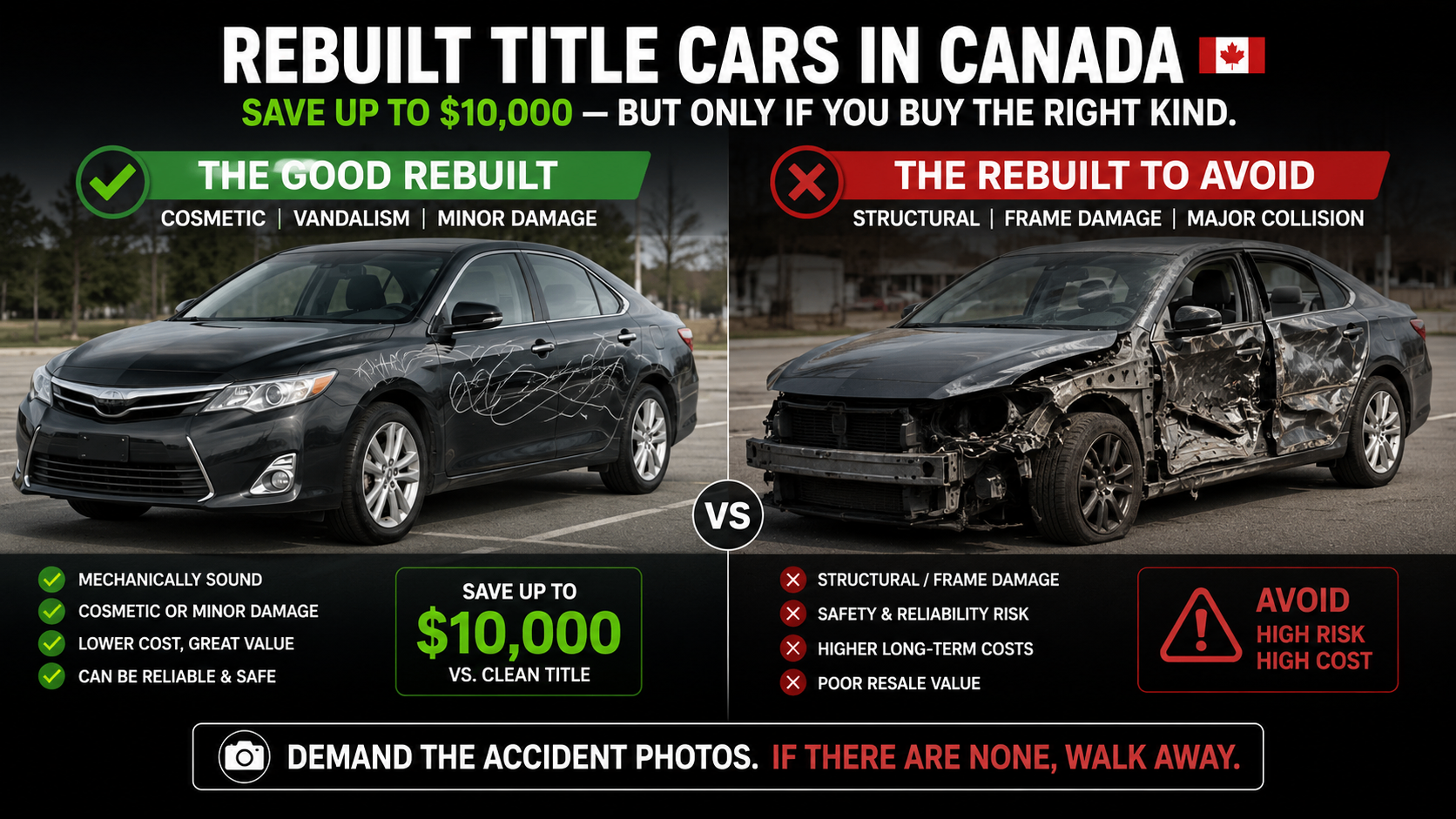
Someone takes a key to a vehicle and scratches every panel on their way around it. Complete act of vandalism. The vehicle runs perfectly. Engine untouched. Frame untouched. Mechanically, nothing is wrong.
But the book value of the vehicle is $10,000. And repainting every panel — properly, with matching paint and blend work — costs $10,000. The insurer declares it a total loss. Salvage title. Rebuilt after repair.
This rebuilt title vehicle is mechanically identical to a clean-title equivalent. The only difference is the paperwork — and the price, which will be significantly lower than clean-title comps because most buyers filter out rebuilt titles without reading why the title was issued.
European Luxury Vehicles: The Same Dynamic, Larger Numbers
The same pattern applies — at larger dollar figures — to European luxury vehicles. German and British vehicles depreciate sharply, meaning their book value falls faster than their repair costs do. A BMW or Mercedes-Benz that is five years old may have a book value of $22,000. A front-end impact that requires bumper replacement, two headlight assemblies, and sensor recalibration can cost $14,000–$18,000 in parts and labour alone.
That repair cost can exceed the salvage threshold without any structural, engine, or airbag involvement. The vehicle gets a rebuilt title. Its market value drops by $8,000–$12,000 relative to clean-title comps. But mechanically, it may be completely sound — because only cosmetic and sensor components were replaced.
Good Rebuilt vs Dangerous Rebuilt: The Distinction That Matters
| Rebuilt Type | What Caused It | Mechanical Risk | Buyer Verdict |
|---|---|---|---|
| Cosmetic / Vandalism | Paint, panels, glass — no mechanical involvement | None | Potentially excellent value |
| Cosmetic impact | Bumper, headlights, fenders — no frame or airbag | Low — verify with photos | Good value if verified |
| European luxury parts cost | High parts cost on low book value vehicle | Low if damage was cosmetic | Good value with photo verification |
| Airbag deployment | Impact force sufficient to trigger airbags | Medium — verify SRS reset documentation | Proceed with caution |
| Structural / Frame damage | Frame rails, pillars, floor pan, unibody deformation | High — avoid | Do not buy |
| Engine or drivetrain failure | Engine replacement, transmission, major mechanical | High — avoid | Do not buy |
| Flood / Fire | Water or heat damage to electrical systems | Very high — avoid | Do not buy under any circumstances |
The Rule That Has No Exceptions: Demand the Accident Photos
The single most important protection when buying a rebuilt title vehicle in Canada is this: demand the original accident photos before you discuss price, before you inspect the vehicle, before you do anything else.
Accident photos show what the vehicle looked like at the time of the insurance claim — before repair. They show where the damage was, how severe it was, and whether any structural or mechanical components were visibly involved. Repair documentation and parts receipts show what was actually replaced.
Compare the accident photos to the current condition of the vehicle carefully. If the repair area described in the documentation does not match what you see in the photos — if the photos show front-end damage but the repair receipts reference structural components that should not have been involved in that impact — that discrepancy is a warning sign.
Rebuilt title fraud is a documented problem in Canada. Vehicles rebuilt from severe structural damage are sometimes represented as cosmetic-only rebuilds. The accident photos are the primary tool that protects buyers from this fraud — which is exactly why sellers involved in fraudulent transactions cannot produce them.
What Rebuilt Title Means for Resale and Trade-In
This is the part that most rebuilt title buyers understand intellectually but do not fully account for when they make the purchase decision.
A rebuilt title stays on the vehicle permanently. There is no process in Canada to clear a rebuilt designation from a title. The brand follows the vehicle for its entire remaining life.
At resale, rebuilt title vehicles sell at a discount of 20–40% below equivalent clean-title units, regardless of current condition or repair quality. This discount reflects buyer perception and the permanently reduced pool of buyers willing to purchase a branded-title vehicle.
At trade-in, the situation is more severe. Most dealers — including ours — assign minimal trade-in value to rebuilt title vehicles. The reason is simple: rebuilt title vehicles are difficult to retail. We cannot represent them as clean-title inventory, our retail buyer pool shrinks significantly, and the pricing has to reflect the permanent discount the market applies. In many cases, a rebuilt title vehicle at trade-in goes to wholesale at a price that gives the dealer almost no margin — which means the trade-in offer reflects that reality.
Insurance on Rebuilt Title Vehicles in Canada
Most Canadian insurers will provide liability coverage on rebuilt title vehicles without significant difficulty. Comprehensive and collision coverage is more complicated — some insurers decline to provide it, others offer it at standard rates, and rates and availability vary by province and insurer.
Before purchasing a rebuilt title vehicle, confirm with your insurer what coverage they will extend and at what premium. In BC, ICBC handles basic coverage for all vehicles, but optional collision and comprehensive coverage on rebuilt titles may be subject to additional inspection requirements or limitations.
Financing is also more restricted. Most major Canadian banks and credit unions will not finance rebuilt title vehicles. If you are planning to finance, confirm lender eligibility before committing to a purchase.
The Self-Assessment: Are You the Right Buyer for a Rebuilt Title Vehicle?
Am I a Good Rebuilt Title Buyer?
If you checked the first three items, a well-chosen rebuilt title vehicle may genuinely suit your situation. If you are uncertain about the last two, the rebuilt title market is not the right place for you to be shopping.
Key Takeaways
- A rebuilt title in Canada means the vehicle was declared a total loss (repair cost exceeded 70–80% of book value), was repaired, and passed a provincial safety inspection. The brand is permanent.
- The reason for the rebuilt title matters more than the title itself. Cosmetic damage, vandalism, and high European luxury parts costs can produce rebuilt titles on mechanically sound vehicles. Engine destruction and structural frame damage produce rebuilt titles on genuinely compromised vehicles.
- A good rebuilt title vehicle can save you up to $10,000 compared to a clean-title equivalent — and may be more transparent than a cheap clean-title vehicle with unknown history.
- Demand the accident photos before anything else. No photos = no purchase. This is not negotiable.
- Compare accident photos to repair documentation carefully. Discrepancies between what the photos show and what the repair receipts claim are warning signs of fraud.
- Rebuilt title vehicles carry a permanent 20–40% resale discount and minimal trade-in value at most dealers. If you plan to trade in within five years, a rebuilt title vehicle is the wrong purchase.
- Insurance coverage — particularly comprehensive and collision — requires verification before purchase. Financing from major lenders is often unavailable.
- Rebuilt title buying is right for you if you plan to keep the vehicle long-term, prioritize transportation over resale value, and are willing to do the verification work the purchase requires.
Check the Market Value of a Rebuilt Title Vehicle Before You Negotiate
Understanding what a clean-title equivalent is worth in the current Canadian market is the starting point for evaluating any rebuilt title vehicle's price. Know the spread before you decide.
Get My Free Estimate →RIDEZ Canada — Rebuilt Salvage Title Canada: Critical Hidden Traps in 2026 (March 2026) — Canadian 70–80% salvage threshold | Canadian Black Book 2026 Market Preview — rebuilt title resale value discount data | Direct dealership experience — Autoteque Auto Group, British Columbia, 2022–2026 | CARFAX Canada — rebuilt title documentation standards
Carestify
Get Your Free Car Valuation Instantly
Quickly check your car's fair market value with our structured data inputs and AI-powered analysis tailored to the Canadian market.
Check My Car Value for Free