Carestify Press
RSS FeedShould You Buy an Extended Warranty on a Used Car in Canada? A BC Dealer's Honest Breakdown
July 6, 2026 · Noah Minami
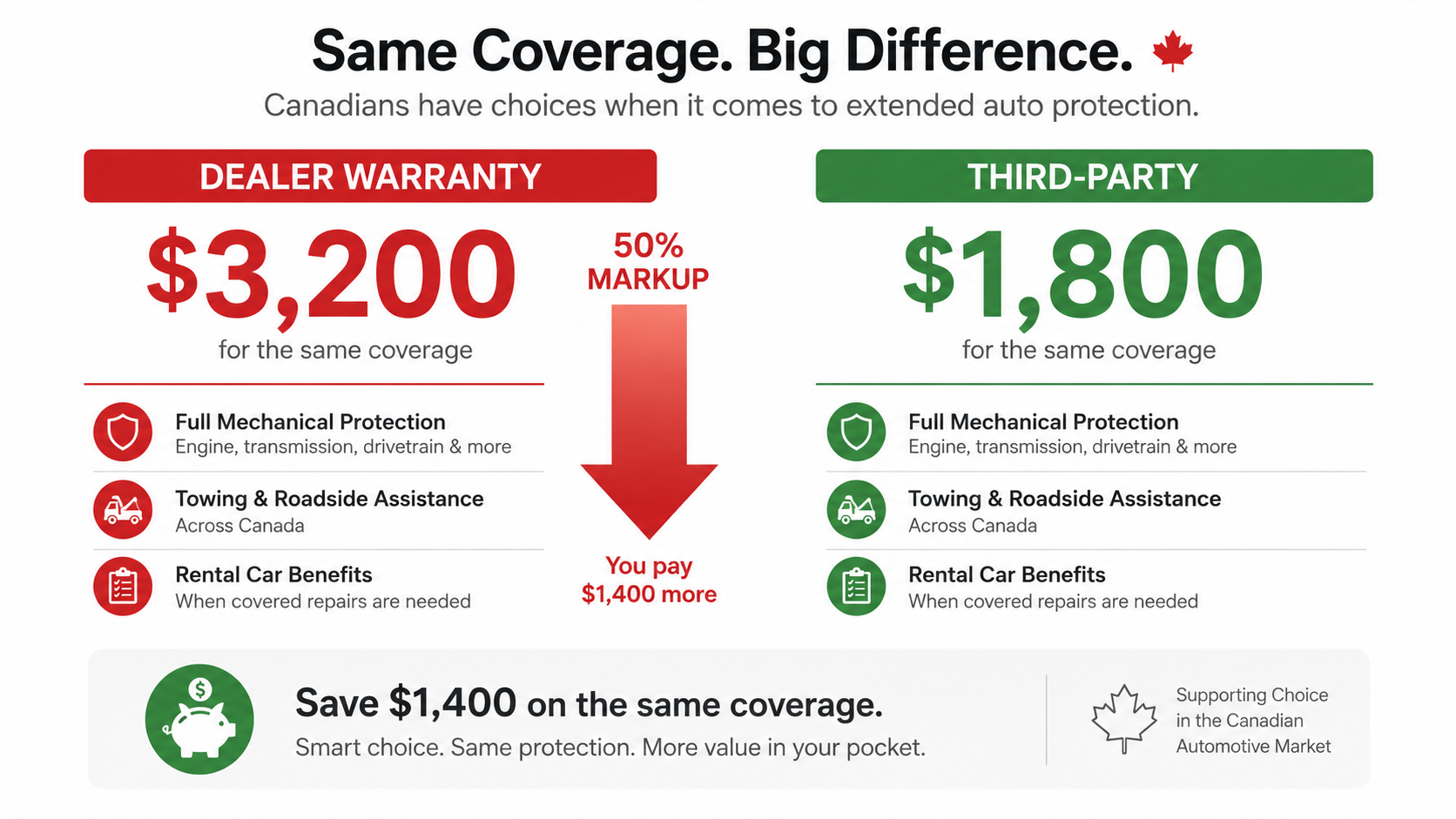
(CAD, 2026)
warranty cost
their warranty (Consumer Reports)
dealer price
What the F&I Office Doesn't Tell You
I work in the automotive business in British Columbia. I have sat across the desk from the Finance and Insurance office hundreds of times — on both sides of it. The extended warranty presentation is one of the most rehearsed sales processes in the dealership. It is designed to create urgency, leverage the emotional high of buying a vehicle, and convert hesitation into a signature before you have time to compare alternatives.
That does not mean extended warranties are a scam. Some of them provide genuine value in specific situations. But the F&I office is, by design, a profit centre — not a neutral advisory service. Dealer-sold extended warranties in Canada currently carry markups of 50–100% over their actual cost, according to data from the Automobile Protection Association. The same coverage available for $1,800 from a third-party provider often appears on a dealer's finance worksheet at $3,200 to $3,800.
The purpose of this article is to give you the framework that separates situations where a warranty is a defensible financial decision from situations where it is a high-margin product you do not need.
How Extended Warranties in Canada Actually Work
An extended warranty — more accurately called a Vehicle Service Contract (VSC) or Extended Service Agreement — is a contract that covers the cost of specified mechanical repairs after the manufacturer's factory warranty expires. It is not insurance, and it is not the same as the manufacturer's warranty that comes with the vehicle.
In Canada, extended warranties are sold through three main channels:
- Manufacturer-backed programs — purchased through franchised dealerships, tied to the original OEM warranty structure. Generally the most seamless for claims but the most expensive.
- Dealer-arranged third-party contracts — the dealership sells a contract underwritten by an independent administrator. The dealer marks up the contract by 50–100% and the administrator handles claims. This is the most common category at independent dealerships.
- Direct third-party providers — purchased directly from companies like Ensurall, Global Warranty, or GuardTree without going through a dealership. Typically 30–60% cheaper than dealer-arranged equivalents for the same coverage tier.
What Extended Warranties Cover — and What They Don't
Coverage varies by plan tier. Most contracts fall into two categories:
Powertrain-Only Coverage
Covers the engine block, cylinder heads, transmission, drive axles, and transfer case. Does not cover electrical systems, suspension, air conditioning, fuel delivery, or electronics. This is the lowest-cost tier and provides the narrowest protection. For most buyers, powertrain-only coverage is insufficient on vehicles older than six years, because non-powertrain failures become increasingly common past that point.
Comprehensive (Bumper-to-Bumper) Coverage
Covers most mechanical and electrical components with a defined exclusions list. Air conditioning, suspension, electronics, and fuel systems are typically included. Wear items — brake pads, rotors, tires, filters, belts — are universally excluded from all plans. This tier costs more but provides meaningful protection on vehicles with complex electrical architectures or known failure-prone systems.
| Component | Powertrain Plan | Comprehensive Plan |
|---|---|---|
| Engine internals | ✅ Covered | ✅ Covered |
| Transmission | ✅ Covered | ✅ Covered |
| Air conditioning | ❌ Excluded | ✅ Covered |
| Electrical systems | ❌ Excluded | ✅ Covered |
| Suspension components | ❌ Excluded | ✅ Covered |
| Fuel delivery system | ❌ Excluded | ✅ Covered |
| Brake pads/rotors | ❌ Excluded | ❌ Excluded |
| Tires | ❌ Excluded | ❌ Excluded |
| Routine maintenance | ❌ Excluded | ❌ Excluded |
The Decision Framework: Mileage, Model Year, and Vehicle Type
The single most important variable in the warranty decision is not price — it is the statistical probability that your specific vehicle will require a covered repair during the warranty period. That probability is determined primarily by mileage, model year, and vehicle type.
Mileage Thresholds
Past 120,000 km, most vehicles have exited the low-maintenance phase. Timing chains, water pumps, turbocharger bearings, transmission solenoids, and electronic control modules begin to show age-related failure patterns. For vehicles in this mileage band, a comprehensive warranty can provide meaningful financial protection — particularly on European and American brands with historically higher component costs.
This range is model-dependent. For Toyota, Honda, and Mazda vehicles, this mileage band typically represents a low-risk period — these platforms are well past break-in but have significant life remaining on major components. For German brands (BMW, Audi, Mercedes-Benz, Volkswagen), turbocharged vehicles, and vehicles with dual-clutch transmissions, this range begins to see elevated repair frequency.
Consumer Reports data shows that 55% of extended warranty purchasers never use their coverage. Vehicles under 80,000 km from Toyota, Honda, Hyundai, and Mazda have historically low mechanical failure rates in this mileage band. Paying $2,000–$3,500 for coverage on a 2021 Toyota Camry with 55,000 km is statistically poor value for most buyers.
Model Year Guidelines
| Vehicle Age | General Guidance | Exception |
|---|---|---|
| 0–3 years | Skip — factory warranty likely active | Check remaining factory coverage before purchasing |
| 3–5 years (domestic) | Evaluate — domestic brands show earlier wear patterns | Ford, GM, Chrysler/Stellantis: higher repair frequency past year 5 |
| 3–6 years (Japanese) | Generally skip | Toyota and Honda: lower mechanical risk through year 7–8 |
| 5–7 years (European luxury) | Strong buy case | BMW, Audi, Mercedes, Jaguar, Range Rover: high per-claim repair costs |
| 7+ years (any brand) | Evaluate carefully | Some providers won't cover vehicles this age; check eligibility first |
Vehicle Type: The Most Overlooked Variable
German and British Luxury — The Clearest Buy Case
A single out-of-warranty repair on a BMW, Audi, Mercedes-Benz, or Range Rover can cost more than the entire warranty premium. Ensurall's 2024 claims data shows German luxury vehicles averaging $3,847 per claim versus $2,284 for domestic brands. Air suspension systems on Range Rover and Mercedes-Benz models, mechatronic units in BMW dual-clutch transmissions, and high-voltage components on German hybrids are particularly expensive and failure-prone past 80,000 km. For these vehicles, a comprehensive warranty at any mileage past 60,000 km deserves serious consideration.
Turbocharged Engines — Elevated Risk Regardless of Brand
Turbocharger bearing failure, boost pressure sensor issues, and intercooler degradation are not brand-specific problems — they affect turbocharged engines across all manufacturers. If the vehicle you are purchasing has a turbocharged engine and is past 100,000 km, this is a meaningful risk factor regardless of whether the badge says Ford EcoBoost, Volkswagen TSI, or Hyundai Theta. A powertrain-inclusive warranty becomes more defensible in this scenario.
Dual-Clutch Transmissions (DCT)
Dual-clutch transmissions are among the most expensive drivetrain components to replace — typically $4,000 to $7,000 CAD for parts and labour. They appear in a wide range of vehicles including Volkswagen (DSG), Ford (PowerShift), Hyundai/Kia (wet DCT), and some Honda applications. If the vehicle has a DCT and is approaching or past 80,000 km, warranty coverage for the transmission specifically is worth the cost of entry.
High-Reliability Platforms — The Skip Case
Toyota Camry, Corolla, RAV4, and 4Runner. Honda Accord, CR-V, and Pilot (pre-2023 naturally aspirated versions). Mazda3 and Mazda CX-5. These platforms have decades of reliability data supporting lower mechanical failure rates across their primary systems. Paying a premium warranty for these vehicles under 100,000 km is a statistically poor use of capital for most buyers. The APA recommends directing warranty premium savings into a dedicated repair fund for these vehicles instead.
How Much Should You Actually Pay?
| Vehicle Type | Dealer Price Range (CAD) | Third-Party Price Range (CAD) | Dealer Markup |
|---|---|---|---|
| Compact car (civic, corolla) | $1,800–$2,800 | $900–$1,600 | 50–75% |
| Mid-size SUV (CR-V, RAV4) | $2,200–$3,400 | $1,200–$2,000 | 60–80% |
| Full-size truck (F-150, Silverado) | $2,800–$4,200 | $1,600–$2,600 | 55–75% |
| German luxury (BMW, Audi, Mercedes) | $3,500–$5,500 | $2,000–$3,500 | 50–100% |
| British luxury (Jaguar, Range Rover) | $4,000–$6,500 | $2,500–$4,000 | 60–100% |
Province-by-Province: What Legal Protections You Already Have
Quebec — The Strongest Legal Warranty in Canada
Quebec buyers have a significant advantage that most fail to use. Under Articles 1726–1731 of the Civil Code of Quebec, every vehicle sold in the province carries an implied warranty of quality. The vehicle must function properly for a reasonable period relative to its price, age, and condition — regardless of whether a paid warranty was purchased. This provision can make paid extended warranty products partially redundant for Quebec buyers, particularly on vehicles under five years old.
British Columbia
The BC Business Practices and Consumer Protection Act provides a cooling-off period on certain contracts and disclosure requirements for warranty sales. Dealers must provide written disclosure of what is and is not covered before you sign. Unlike Quebec, BC does not provide a statutory implied warranty on used vehicles sold "as-is" by private sellers — the dealer sale context is different.
Ontario, Alberta, and Other Provinces
Provincial consumer protection legislation provides additional rights including cancellation options and disclosure requirements. CAMVAP (Canadian Motor Vehicle Arbitration Plan) offers free, binding arbitration for warranty disputes between consumers and manufacturers in every province except Quebec — a valuable recourse if a covered claim is wrongfully denied.
The Third-Party Alternative: What to Look For
If you decide a warranty is appropriate for your vehicle, purchasing directly from a third-party provider rather than through the dealership is almost always the better financial decision. Key factors to evaluate:
- Claims process — Verify whether you must use the provider's network shops or if you can use any licensed mechanic in Canada. Network-restricted plans can create significant inconvenience, particularly in rural BC or Northern Ontario.
- Administrator history — The warranty is only as good as the company that processes claims. Check BBB ratings and reviews on Google for the specific administrator, not the selling dealer.
- Exclusions list — Read it entirely before purchasing. "Comprehensive" plans vary widely in what they exclude. Pre-existing conditions, wear-related failures, and maintenance-adjacent repairs are commonly denied.
- Cancellation and refund terms — Confirm the pro-rated refund formula and any administrative fees that apply if you sell the vehicle before the warranty expires.
- Transferability — A transferable warranty adds resale value. A non-transferable warranty does not. This affects both your flexibility and the vehicle's future market value.
The Repair Fund Alternative
For high-reliability vehicles under 100,000 km, the APA and Consumer Reports both suggest an alternative: take the $2,000–$3,000 you would have spent on a warranty and place it in a dedicated vehicle repair savings account. This approach has several structural advantages over a warranty contract:
- No exclusions — the money covers any repair, including those a warranty would deny
- No deductible — the full amount is available for any repair
- You keep the money if no major repairs occur (a statistical likelihood for reliable brands under 100,000 km)
- No network restrictions — use any mechanic
This strategy works best when the vehicle has a documented maintenance history and has been inspected by an independent mechanic before purchase. It is a poor strategy for vehicles with uncertain maintenance records, unknown previous use, or known failure-prone systems.
The Reality No Inspection Can Guarantee
Here is something I have seen more than once in this business, and it is the part that does not appear in any warranty brochure.
A used vehicle goes through a full 150-point inspection. Every fluid checked. Every seal examined. A test drive completed under highway and city conditions. The technician signs off. The reconditioning team goes through it. By every measurable standard, the vehicle passes.
Three weeks after delivery, the buyer calls. Something is wrong. It might be an intermittent electrical fault that only surfaces under specific temperature conditions. It might be a transmission shudder that appears only above 90 km/h after the fluid warms up. It might be an oil leak from a seal that was dry at inspection time and began seeping after normal heat cycles.
These are not failures of the inspection process. A 150-point inspection is a snapshot in time, not a prediction of future behaviour. Used vehicles have history, wear patterns, and component fatigue that no pre-delivery inspection — however thorough — can fully surface.
Buyers who declined the extended warranty in these situations paid out of pocket. In most cases, they were driving vehicles that had been properly inspected, properly reconditioned, and properly represented at the point of sale. The inspection did its job. The warranty would have done a different job — one that the inspection cannot do.
This does not mean every buyer should purchase a warranty. The statistical arguments against warranties on reliable vehicles under 100,000 km remain valid. But it does mean the warranty decision should not be made on the assumption that a clean inspection removes all financial risk. It reduces it. It does not eliminate it.
Quick Decision Guide: Should You Buy?
- German or British luxury brand at any mileage past 60,000 km
- Any brand with a turbocharged engine past 100,000 km
- Any brand with a dual-clutch transmission past 80,000 km
- Vehicle with incomplete or unknown service history
- Budget constraints make a large unexpected repair financially disruptive
- Domestic brands (Ford, GM, Stellantis) between years 5–7
- Any vehicle between 100,000–140,000 km regardless of brand
- Vehicles with a single minor accident record (check CARFAX Canada first)
- AWD/4WD vehicles past 100,000 km in salt-belt provinces
- Toyota, Honda, Mazda under 100,000 km with documented service history
- Any vehicle still within manufacturer's factory warranty period
- Quebec buyers on vehicles under 5 years old (implied warranty likely applies)
- Vehicles where the warranty cost exceeds 8–10% of the vehicle's purchase price
One More Thing: Know Your Car's Value Before You Negotiate Anything
Every decision made in the F&I office — including the warranty — is made more clearly when you know the actual market value of the vehicle you just purchased. If you paid $4,000 over market value for a vehicle and then added a $3,200 warranty at dealer markup, you have spent $7,200 on value that is difficult to recover. Understanding your vehicle's real market position before you sit down in the finance office is the single most effective negotiating tool available to a Canadian used car buyer.
Key Takeaways
- Dealer-sold extended warranties carry 50–100% markups over actual cost. Third-party providers offer equivalent coverage at 30–60% less.
- The decision is mileage and vehicle-type dependent — not a universal yes or no.
- Strong buy case: German/British luxury, turbocharged engines past 100,000 km, dual-clutch transmissions past 80,000 km.
- Skip case: Toyota, Honda, Mazda under 100,000 km with documented service history.
- Quebec buyers have implied warranty protections under the Civil Code that can partially replace a paid warranty.
- 55% of warranty purchasers never use their coverage — statistically, reliable brands under 100,000 km are poor warranty candidates.
- Read the exclusions list entirely before signing. "Comprehensive" coverage varies widely by provider.
- A transferable warranty adds resale value; verify transferability before purchasing.
- For reliable vehicles, a dedicated repair savings fund outperforms a warranty contract structurally.
Automobile Protection Association (APA) — Extended Warranty Info | Ensurall Canada — 2024 Claims Analysis, Vehicle-Specific Warranty Cost Guide | RIDEZ Canada — Extended Warranty Cost Canada: 5 Critical Signs It Pays Off (March 2026) | Consumer Reports — Extended Warranty Usage Data | Civil Code of Quebec, Articles 1726–1731 | BC Business Practices and Consumer Protection Act | CAMVAP (Canadian Motor Vehicle Arbitration Plan)
Carestify
Get Your Free Car Valuation Instantly
Quickly check your car's fair market value with our structured data inputs and AI-powered analysis tailored to the Canadian market.
Check My Car Value for Free