Carestify Press
RSS FeedWhy the Price Changes When You Get to the Dealership — And How to Make Sure It Doesn't
July 24, 2026 · Noah Minami
seller disclosed
claim amount
on damaged vehicles (Canada)
with damage history
The Complaint I Hear All the Time
"The dealer quoted me one price on the phone and then tried to lowball me when I got there."
I hear this constantly. From private sellers. From buyers. On forums, in reviews, in conversations with people who have had frustrating dealership experiences. The assumption behind the complaint is almost always the same: the dealer was dishonest, used a bait-and-switch, and tried to take advantage of the seller after they had already driven across the city.
Sometimes that is exactly what happened. There are dealers who operate that way, and I am not going to pretend otherwise.
But more often than most people realize, the price change at the lot happens for a different reason entirely — and that reason originates with the seller, not the dealer.
What Happened This Week: A Real Example
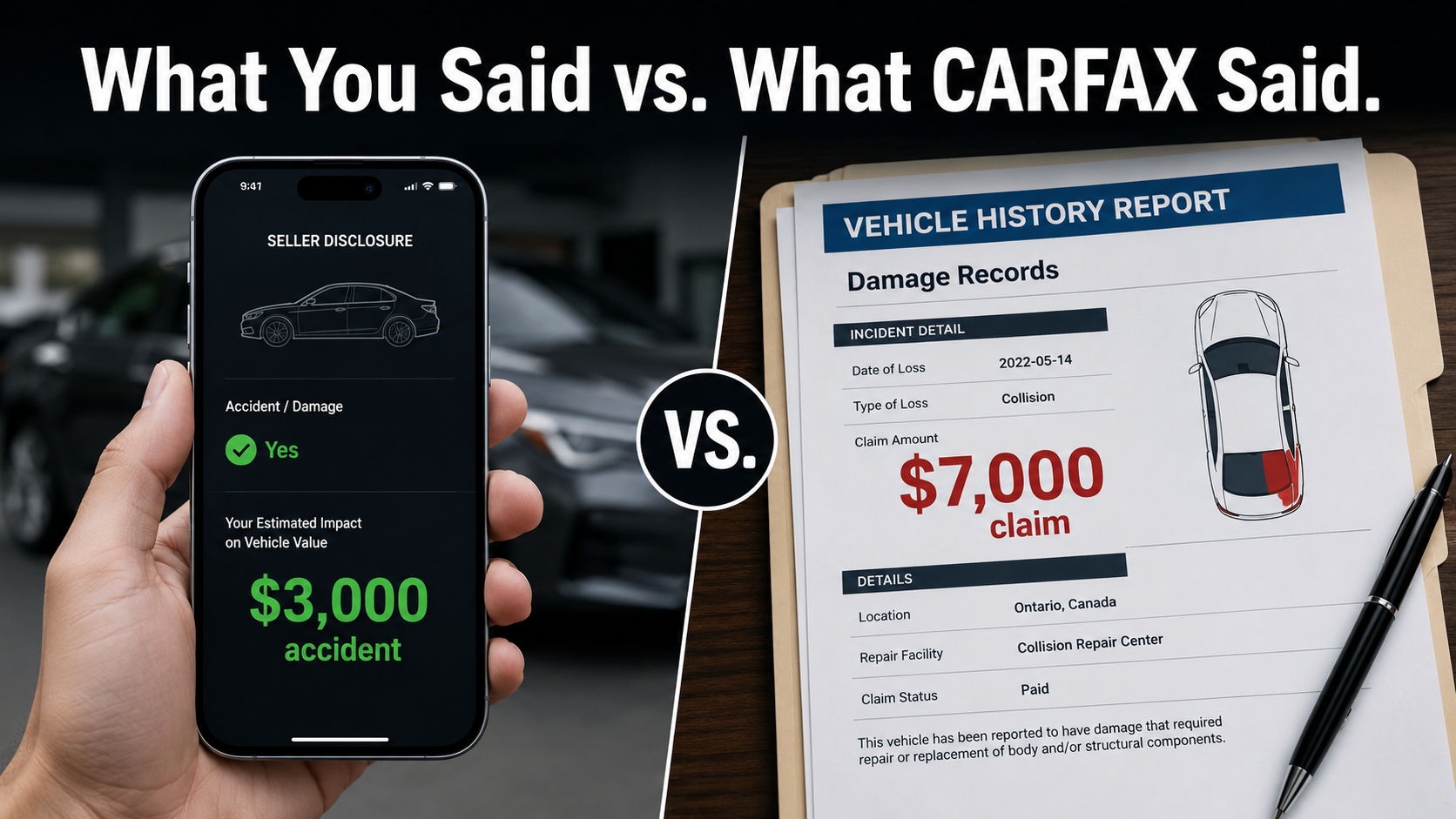
This week I was purchasing a vehicle from a private seller. The transaction moved through the initial stages normally. We discussed the vehicle over the phone — year, make, model, mileage, condition. The seller mentioned there was an accident on the record. They said it was approximately $3,000. The vehicle looked clean, they said. No visible damage remaining.
Based on that information, I worked out a price. We agreed on a number. I invited the seller to come in to finalize the paperwork.
Here is something about how I operate: I do not run a full CARFAX on every vehicle during initial inquiries. Each CARFAX report has a cost. When I am dealing with dozens of potential acquisitions at any given time, running a full report on every initial contact is not economically practical. I run CARFAX at the final confirmation stage — when both parties have agreed on terms and we are ready to sign.
The seller came in. We were ready to sign. I pulled the CARFAX.
The accident claim was not $3,000. It was $7,000.
Why $3,000 and $7,000 Are Not the Same Thing
To someone without direct experience in used vehicle pricing, a $4,000 difference in an accident claim might seem minor relative to the total vehicle price. It is not.
CARFAX Canada data shows that vehicles with reported damage history sell at an average discount of $7,464 below equivalent clean-title units. That discount is not linear — it is not simply the claim amount subtracted from the clean-title price. It reflects market perception, buyer psychology, and the uncertainty that any damage history introduces about repair quality and long-term integrity.
| Accident Claim Amount | Market Perception | Typical Buyer Response | Price Impact |
|---|---|---|---|
| Under $3,000 | Minor — likely cosmetic | Most buyers proceed with minor negotiation | Moderate discount |
| $3,000–$5,000 | Moderate — panel or component repair | Buyers negotiate; some walk away | Meaningful discount |
| $5,000–$8,000 | Significant — structural risk perceived | Many buyers require independent inspection; stronger negotiation | Significant discount required |
| Over $8,000 | Major — serious concern for most buyers | Large portion of buyer pool eliminated | Largest discount tier |
A $3,000 claim and a $7,000 claim are in different categories entirely. The price I agreed to with this seller was calculated on a $3,000 history. The vehicle I was actually purchasing had a $7,000 history. Those are not the same vehicle, financially speaking.
Put Yourself in the Other Position
Before I continue, I want to ask you to do something. Reverse the situation entirely.
Imagine you are buying a vehicle from a dealer. Over the phone, the dealer tells you the vehicle has a clean history — no accidents. You drive an hour to see it. You are ready to buy. The dealer pulls out the paperwork and casually mentions that, actually, there was a minor accident — about $3,000. Nothing major.
What is your reaction?
Most people reading this would feel deceived. They would demand a price reduction to reflect the accident history. Some would walk away entirely. Almost no one would say "that's fine, same price, let's sign."
And they would be right to feel that way. Information that materially affects the value of a vehicle is information that needs to be disclosed before a price is agreed upon — not after both parties have shown up to sign documents.
How This Transaction Actually Ended
In this case, I went ahead with the purchase at the originally agreed price. Not because the $7,000 CARFAX did not affect my valuation — it did. But because the overall deal still worked at that number given other factors specific to this vehicle and my inventory needs.
That is not always the outcome. I have walked away from deals at the signing stage because the CARFAX came back materially different from what was described. I have renegotiated prices downward after the report came in. I have watched sellers leave frustrated, believing the dealer changed the price unfairly — when in fact the dealer was reacting to information the seller had not disclosed accurately.
Why Sellers Sometimes Get the Number Wrong
To be fair to sellers: not every discrepancy is intentional. There are legitimate reasons why a seller might quote a different accident amount than what appears on CARFAX.
- Insurance supplement payments — An initial estimate may have been $3,000, but supplemental claims for hidden damage found during repair brought the total to $7,000. The seller may have only remembered the original estimate.
- Multiple claims aggregated — What appears on CARFAX as a single $7,000 claim may represent multiple repair visits for the same incident, with amounts the seller tracked separately.
- Out-of-pocket repairs not disclosed — Some sellers had repairs done outside of insurance to avoid premium increases. These may not appear on CARFAX at all — but the damage they repaired may be relevant.
- Genuine memory gap — The accident may have happened years ago and the seller simply does not remember the exact amount.
None of these explanations change the outcome at the signing table. But they are worth understanding because they affect how both parties should approach the information-sharing process before a deal is struck.
The Only Solution: Full Disclosure Before the Price
Whether you are a private seller dealing with a dealer, a private seller dealing with a private buyer, or a dealer acquiring from another dealer — the principle is the same.
All material information about the vehicle should be on the table before a price is agreed upon.
Not after both parties have driven to meet. Not after the paperwork is laid out. Before the number is discussed.
For sellers, this means:
- Pull your own CARFAX before listing or contacting buyers. Know exactly what is on the record — not approximately.
- Disclose the exact claim amount, not a rounded estimate.
- Disclose any repairs you know about, including out-of-pocket work that may not appear on CARFAX.
- If you are unsure about the history, say so — do not estimate in a direction that favours your asking price.
For Buyers: How to Protect Yourself
If you are on the buying side of this dynamic — whether purchasing from a dealer or a private seller — the single most effective protection is simple: get the CARFAX before you make the trip.
Ask the seller for the VIN. Run the report yourself or request that they provide it before you commit to showing up. A seller who refuses to provide the VIN or discourages you from running a CARFAX is telling you something important about what that report would show.
For dealers specifically: understand that a legitimate dealer who adjusts a price after discovering undisclosed damage is not necessarily being dishonest. They are responding to information they did not have when they quoted you. The question to ask is whether the new price reflects the vehicle's actual value given everything that is now known — or whether it represents an opportunistic additional discount beyond what the new information justifies.
Key Takeaways
- The most common reason a dealer price changes between the phone call and the lot visit is that new information about the vehicle emerged — not that the dealer decided to lowball after getting you there.
- A $3,000 accident claim and a $7,000 accident claim are in different pricing tiers. The difference materially affects vehicle value and buyer pool size.
- CARFAX Canada data shows damaged-history vehicles sell at an average $7,464 discount below clean-title equivalents. The exact claim amount affects where within that discount range a vehicle lands.
- Sellers who disclose everything upfront protect the deal. Disclosing a $7,000 accident history before a price is agreed is far less damaging than having it discovered at the signing table.
- Buyers should request the VIN and run a CARFAX before making the trip — not after arriving and falling in love with the vehicle.
- The reverse transparency test applies equally: if a dealer told you the car was clean and it wasn't, you would demand a reduction or walk. The same logic applies when a seller misrepresents accident history to a dealer.
Know Your Vehicle's Real Market Value Before Any Conversation
Whether you are buying or selling, understanding your vehicle's current market value — including the impact of accident history — is the foundation of any fair transaction. Get a free estimate before you negotiate.
Get My Free Estimate →CARFAX Canada June 2026 Used Vehicle Market Insights (average damage discount: $7,464 CAD; 30.9% of listings carry damage history) | Direct dealership transaction experience — Autoteque Auto Group, British Columbia, July 2026
Carestify
Get Your Free Car Valuation Instantly
Quickly check your car's fair market value with our structured data inputs and AI-powered analysis tailored to the Canadian market.
Check My Car Value for Free