Guide
A Deep-Dive Analysis of the Canadian Market
How climate, geography, tax rules, and buyer psychology shape vehicle value in Canada
Climate corridors, provincial trade-in tax dynamics, history reports, warranty and tech expectations—and how CAR:estify helps you read the Canadian curve with more context, not false precision.
Introduction: Why Canadian Depreciation Feels Different
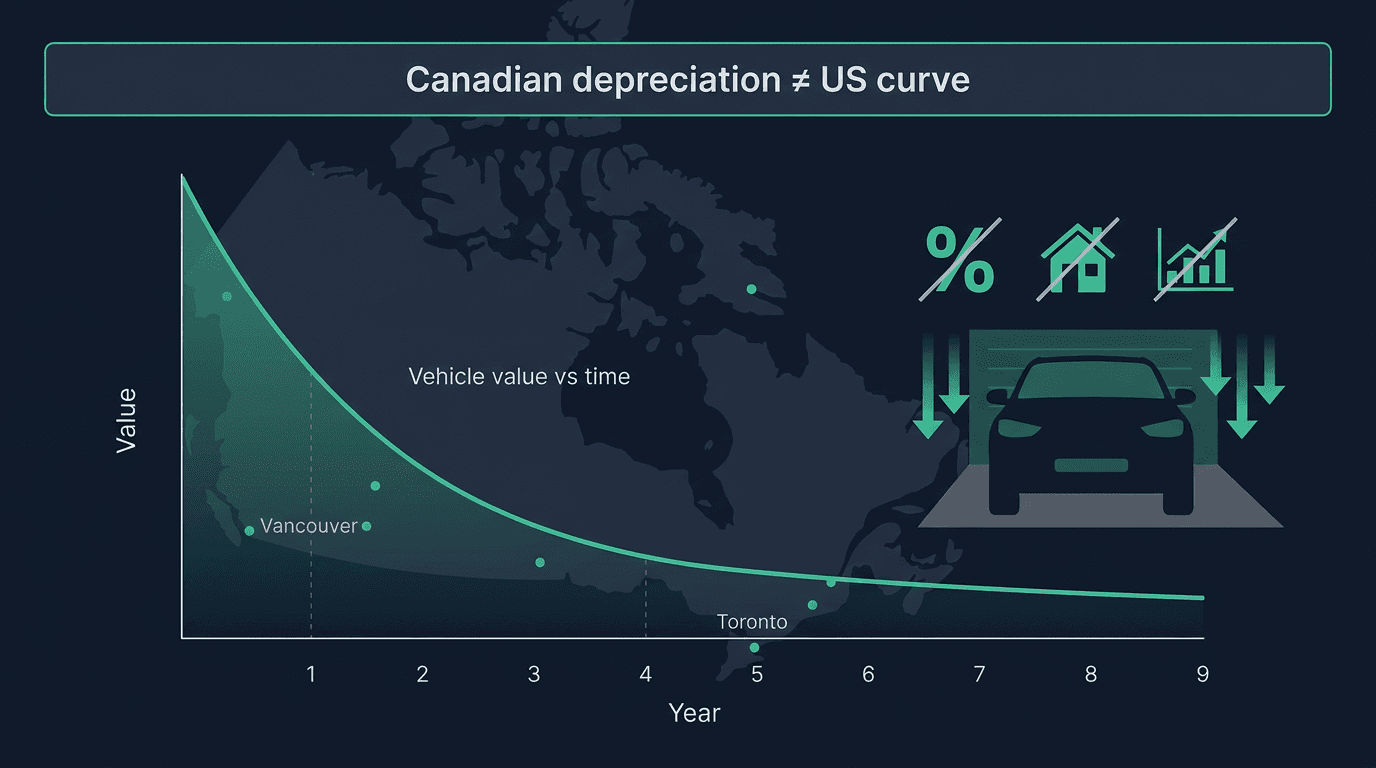
Most Canadian households watch interest rates, markets, and housing more closely than the car in the driveway. Yet vehicles are often one of the largest recurring wealth drains in a family budget. Depreciation is not just "the price went down." It reflects liquidity (how easily you can sell), perceived risk, regional demand, and how quickly a model feels outdated.
In Canada—with harsh winters, long distances between markets, and province-specific tax rules—those forces interact in ways U.S. rules of thumb often miss. Understanding the "asset lifecycle" does not guarantee a fixed dollar outcome, but it can help you avoid expensive timing mistakes and negotiate from a clearer position.
Pillar 1: Core Principles of Vehicle Depreciation
1.1 Steep Early Loss, Then a Slower Curve
Depreciation is rarely a straight line. In practice it often resembles an exponential decay pattern: the steepest relative loss commonly appears early, then the pace of decline can moderate—though markets, models, and condition still matter a great deal.
The registration step-down: once a New Vehicle Information Statement (NVIS) is filed with a provincial ministry (for example ICBC in B.C. or MTO in Ontario), the vehicle is no longer "new" in market terms. That change in status typically reduces what a subsequent buyer will pay compared with an identical unit still sitting as new inventory. The size of that gap varies by brand, demand, and how scarce the model is—it is directional, not a fixed national percentage.
The early ownership years: for many mainstream vehicles, the first year of ownership is among the steepest stretches of the curve. Over the following years, value often continues to erode as a share of remaining market value, then may settle into a slower phase once the car is firmly in the used segment. Exact residual percentages versus MSRP differ widely by segment, powertrain, and economic cycle—treat published "average" curves as orientation, not a forecast for your VIN.
1.2 Residual Value vs. Market Value
It helps to separate residual value (what a lessor or guide book may assume at lease end) from fair market value (what a buyer in Burnaby, Toronto, or Calgary will actually pay today). In Canada, the gap between those figures is often influenced by brand reputation, reliability perception, and local supply—sometimes described informally as prestige or reliability premiums—rather than by a single national formula.
Pillar 2: Distinctly Canadian Market Drivers
Canada's used-car market does not simply mirror the United States. Climate, regional industry, and provincial rules create a distinct depreciation ecosystem.
2.1 Winter, Salt, and Seasonal Demand
Climate is not only a driving inconvenience—it shapes buyer preferences and inspection focus.
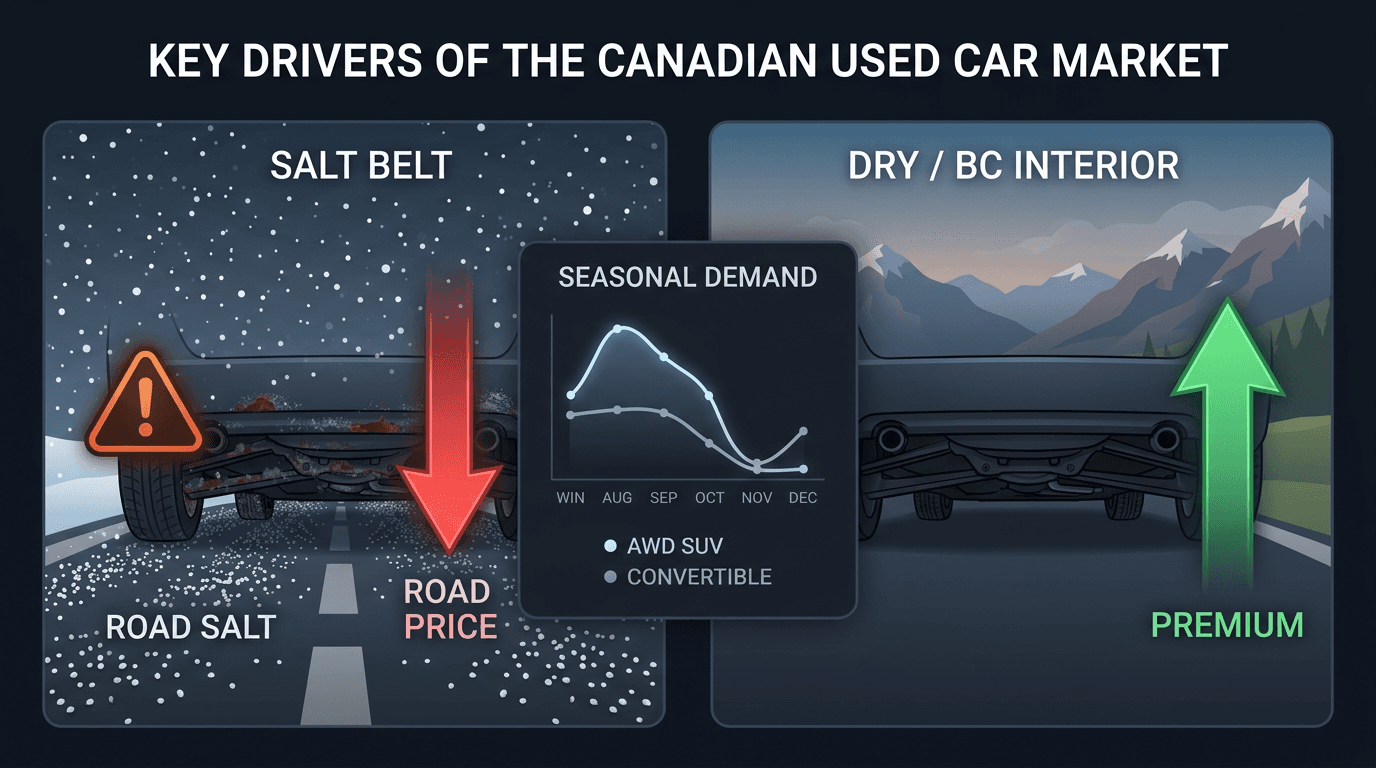
- Regional condition premiums: vehicles from salt-heavy corridors (parts of Ontario, Quebec, and the Maritimes) often face tougher scrutiny for underbody corrosion than units that spent more of their life in drier interior B.C. markets. Coast and metro buyers may prefer locally owned cars for that reason. How much extra they will pay is situational—age, rust evidence, service history, and competing listings matter more than any single city "premium."
- Seasonal demand pivots: convertibles and rear-drive sports cars often become harder to sell as winter approaches, while AWD SUVs and trucks can see stronger interest during cold months. That does not freeze depreciation forever; it can temporarily support asking prices when demand outpaces nearby supply.
2.2 Provincial Taxation and Trade-In Dynamics (B.C. Focus)
Provincial sales tax rules on used vehicles vary. In British Columbia, PST treatment of vehicle purchases and dealer trade-ins can change the economics of where you sell—even when the "book" value of the car is unchanged.
Trade-in tax credit (concept): when you trade at a dealer, tax is often calculated on the difference between the purchase price and the trade-in allowance rather than on the full purchase price alone. That creates a practical "shadow value" for some sellers: the tax savings can make a dealer path more attractive than a private sale at a similar headline price.
Illustrative example only: if B.C. PST applies at 12% and a trade-in allowance reduces the taxable base by $30,000, the tax savings on that allowance alone would be $3,600—raising the effective value of the trade relative to a private sale where the buyer pays tax separately (or structures the deal differently). Actual rates, exemptions, and calculations depend on current provincial rules and the transaction structure; always confirm with a dealer or official B.C. tax guidance rather than treating this as universal advice.
Pillar 3: History Reports, Warranty, and Technology
3.1 Accident History and Information Asymmetry
In a digital marketplace, a vehicle's reported history travels with it. Buyers and dealers routinely check services such as CARFAX Canada (and comparable reports) before they commit.
Accident and claim entries can affect resale—but not in a single fixed way. A minor cosmetic repair with clear documentation may matter less than a poorly explained structural claim. Some wholesale and retail buyers treat any recorded claim as a risk flag and ask for a discount; others focus on severity, photos, and shop invoices. There is no universal dollar threshold or percentage "stigma" that applies to every VIN. The practical takeaway: transparency and repair records usually help more than hoping a buyer never asks.
3.2 Warranty and Technology Expectations
Factory warranty sunsets: many new-vehicle comprehensive warranties in Canada are commonly structured around multi-year / kilometre limits (exact terms are set by each manufacturer). When coverage ends, some buyers reprice the car because repair risk shifts more fully to the next owner. That shift can coincide with softer liquidity—especially for brands with higher repair costs—but it is not an automatic cliff for every model.
Tech and powertrain desirability: as hybrids, EVs, and software features evolve, older ICE vehicles with weak fuel economy or without expected convenience features (for example smartphone integration or modern driver-assistance packages) can become harder to sell relative to better-equipped peers. ADAS and connectivity can support desirability for some buyers and raise repair-cost concerns for others. Treat "tech obsolescence" as a demand factor, not a fixed annual percentage penalty.
Pillar 4: Maintenance and Documentation as Negotiation Support
You cannot stop depreciation, but you can reduce how harshly buyers discount uncertainty. As outlined in CAR:estify's "Be Professional" selling mindset, the following habits often strengthen your position without promising a fixed return on every dollar spent.
4.1 Documenting the Asset Lifecycle
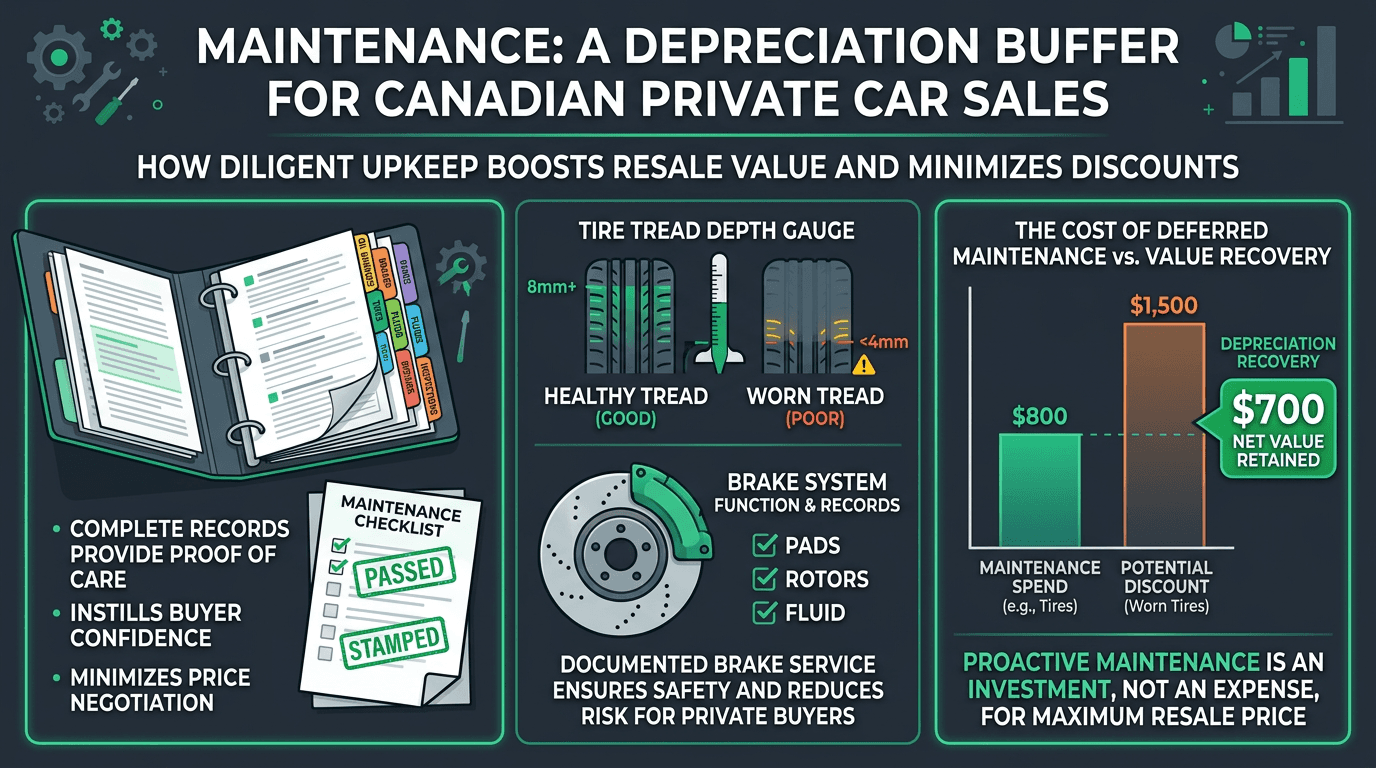
A complete, well-organized service history can reduce the risk discount a cautious buyer applies. Reports, receipts, and a clear timeline do not "create" a set residual uplift; they help the next owner trust that major maintenance was not skipped. Spending a modest amount on history reports and presentation is best viewed as negotiation support, not a guaranteed ROI formula.
4.2 Consumables and Presentation
Worn tires, thin brakes, or overdue services invite buyers to estimate their own replacement costs and deduct them—sometimes aggressively. Fresh rubber and safe brakes will not erase market-wide depreciation, but they can remove an easy excuse for a deep haircut.
Illustrative negotiation logic only: if a buyer plans to demand a large deduction for tires near minimum tread, and you can show recent quality replacements at a lower outlay than their ask, you may protect more of your asking price. Outcomes depend on the local market, how competitive your listing is, and whether the buyer is retail or wholesale. There is no universal "$X spend recovers $Y" rule.
Pillar 5: Timing and Context with CAR:estify
Against depreciation, timing and information often matter as much as polish.
Watching market conditions
Asking prices move with inventory, season, and regional demand. The CAR:estify valuation engine is designed to help owners see a grounded range for their vehicle in Canadian context—so you can judge whether waiting, trading, or listing privately better fits your goals. It is a decision aid, not a promise that there is a single "exact moment" that maximizes every exit.
Mileage and buyer filters
Round-number mileage thresholds (such as crossing 100,000 km) can shrink the pool of interested buyers even when the car is mechanically unchanged. Selling before a widely watched filter, when practical, may preserve liquidity. The benefit is situational—condition, price, and competing listings still dominate.
Conclusion: Reading the Curve Without False Certainty
For many Canadian owners, depreciation is one of the largest costs of keeping a vehicle—often larger than any single fuel or maintenance bill over a multi-year hold. It is also uneven: climate, province, history, warranty status, and equipment all nudge outcomes. Treating those factors as a checklist is more reliable than chasing a national average percentage.
Use CAR:estify to place your vehicle in current Canadian market context, then decide whether to hold, prepare, trade, or sell. Generate a CAR:estify report when you want a structured view of where your asset sits—not a guarantee of a fixed savings amount.
Sources & Methodology
This guide synthesizes high-level patterns commonly discussed across Canadian vehicle ownership and resale practice. It is not a statistical paper and does not claim universal national averages for any single VIN.
Directional reference categories include: Statistics Canada (broader economic and consumer context); Transport Canada (safety and vehicle regulatory framing); manufacturer warranty documentation (coverage limits and terms); Canadian Black Book and similar valuation guides (residual and wholesale orientation); CARFAX Canada and comparable history products (reported incident visibility); and everyday Canadian dealership practice around appraisal, reconditioning, and trade-in tax structuring.
Where examples use dollar amounts or tax arithmetic, they are labeled as illustrative. Market outcomes vary by province, season, model, condition, and buyer type. Always verify current tax rules and warranty terms from official or manufacturer sources before making a financial decision.