The Science of Timing
Understanding Depreciation Cliffs in the Canadian Automotive Market
Warranty sunsets, the 100,000 km search-filter effect, redesign cycles, and seasonal liquidity—practical patterns that help Canadian sellers plan exits before value steps down sharply.
Introduction: The Non-Linear Erosion of Automotive Capital

In the Canadian economy, where households often commit a meaningful share of post-tax income to transportation, understanding step-change depreciation is a practical financial skill. Many owners treat depreciation as a constant, linear decline—a steady loss of cents for every kilometer driven. Canadian secondary-market behaviour is usually more uneven than that picture suggests.
Vehicle value often behaves like a series of cliffs rather than a smooth slope. Chronological, mechanical, and psychological milestones can produce sharper price resets than day-to-day mileage alone. For owners in high-cost-of-living areas like Vancouver, Toronto, or Calgary, crossing those thresholds at an unfavourable moment can mean several thousand dollars of difference over a short listing window. This guide walks through the patterns CAR:estify watches so you can plan timing with clearer context—not guesswork marketed as certainty.
Pillar 1: The "Warranty Sunset" Cliff
In Canada, the approaching end of factory coverage—often discussed as the New Vehicle Limited Warranty (NVLW)—is a common first perception cliff for used-car pricing. Coverage is not one universal Canadian cutoff: it varies by manufacturer, model, powertrain, and whether the remaining limit is measured in time, kilometres, or both. Premium brands such as Audi, BMW, and Mercedes-Benz often see especially noticeable buyer revaluation as remaining coverage shrinks, but the same psychology appears across mainstream nameplates when buyers believe major repairs may soon fall on them.
1.1 The Psychological Shift in Risk Liability
Market perception often shifts around the warranty sunset, not at a single magic odometer reading. A vehicle that still has meaningful factory coverage tends to be framed as an "in-warranty" asset. Once buyers believe coverage has lapsed—or is about to—they reframe the same car as carrying more repair-risk liability. How sharp that shift feels depends on the OEM's warranty schedule and on how buyers in your segment price unexpected shop bills.
- The repair premium: in Canadian luxury and near-luxury segments, a single major repair (for example, a turbocharger failure or an air-suspension leak) can run into the mid-thousands of dollars CAD. Buyers discount for that possibility even when the car is currently healthy.
- The buyer's risk discount: secondary-market shoppers commonly apply a noticeable risk discount once factory coverage is gone or nearly gone. The size of that discount is segment- and condition-dependent—it is not a fixed national percentage.
- The "CPO" paradox: dealerships often pay less for a trade-in that has already crossed a warranty threshold because Certified Pre-Owned (CPO) pathways and reconditioning costs become harder or more expensive without remaining factory coverage.
Practical takeaway: check your specific warranty booklet or manufacturer portal for time/km limits by coverage type (basic, powertrain, corrosion, roadside). Plan listing timing against your remaining coverage—not a one-size-fits-all Canadian rule of thumb.
Pillar 2: The "Six-Figure" Psychological Barrier (100,000 km)
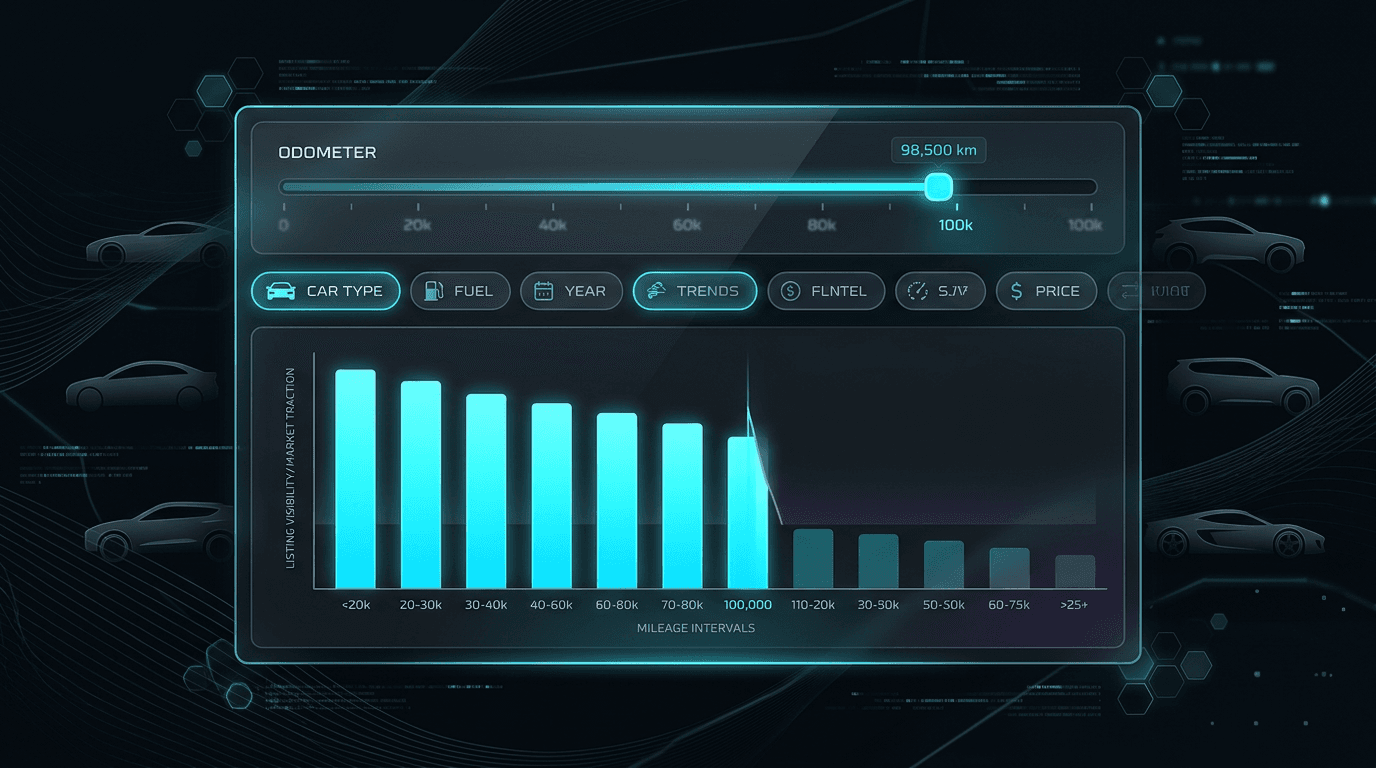
In many Canadian buyers' minds, 100,000 km remains a formidable round-number barrier. Modern vehicles frequently continue well past that mark with proper maintenance, yet the "six-figure" odometer still shapes search behaviour and negotiation tone on private and dealer listing platforms.
2.1 The Digital Filter Wall
A major driver of this cliff is not purely mechanical—it is how people search.
Marketplace filter behaviour: on major Canadian listing sites (and social marketplaces), many shoppers set a hard mileage ceiling near 100,000 km. Once a vehicle crosses that line, it can disappear from a large share of filtered result sets even though the car itself has not suddenly become unreliable. Exact share of the buyer pool varies by platform, category, and season; the important point is the 100k search-filter effect on discoverability.
Illustrative example — popular midsize SUV: imagine a late-model crossover listed just under 100,000 km versus the same vehicle a few thousand kilometres later. The mechanical difference is small, but the listing may need a meaningfully lower ask—or longer days-on-market—simply to regain "eyes" after it falls outside common filter bands. Treat dollar gaps in anecdotes as directional storytelling, not a guarantee for your VIN.
Pillar 3: The "Design Cycle" and Social Obsolescence Cliff
Depreciation is not only about wear and tear; it is also about perceived relevance. When a manufacturer releases a full model redesign (generation change), the previous generation often absorbs an accelerated design-cycle discount as buyers anchor to the new body style, cabin, and feature set.
3.1 The "Old Body Style" Discount
Illustrative example — high-volume compact cars and crossovers: Canadian favourites such as the Honda Civic and CR-V generally hold value well. Still, when a new generation arrives, prior-generation examples can see a sharper short-term soft patch than ordinary mileage aging alone would imply—especially in the first months after the redesign hits dealer lots and advertising.
Technological displacement: cars that lack features buyers now treat as baseline—wireless smartphone integration, modern USB-C ports, or widely advertised driver-assistance packages—can be framed as "legacy tech." That gap does not add a fixed annual percentage to every model, but it often accelerates comparison shopping against redesigns that advertise newer connectivity and assistance hardware.
Pillar 4: The "Consumable Exhaustion" Point

Most vehicles eventually reach a window where several expensive consumables approach replacement at once—tires, brakes, batteries, fluids, and sometimes timing-belt or major service intervals. That window often clusters in the mid-life mileage range, though exact timing depends on driving mix, tire size, and prior maintenance—not a single national kilometre mark.
4.1 The ROI of Pre-emptive Refreshing
In Canada, consumable costs are frequently high because of labour rates, specialized parts, and seasonal tire requirements:
- All-season / winter tires: a quality set for a larger crossover or three-row SUV (for example, popular 20-inch fitments) commonly runs well into four figures CAD before installation and taxes.
- Brake rotors and pads: a full four-wheel service at independent or dealer rates often lands in a similar mid-to-high hundreds or low-thousands band, depending on parts brand and vehicle class.
Negotiation reality: if you list a car that "needs brakes and tires," a prepared Canadian buyer will usually deduct more than the parts alone—they price in shop time, hassle, and uncertainty. As emphasized in the CAR:estify "Be Professional" approach, refreshing obvious consumables before listing can protect asking power when the receipts are clear and the work is documented. Whether that netts a "maintenance profit" depends on local labour quotes, how aggressively buyers negotiate, and whether your market rewards turnkey condition.
Illustrative example: spending a couple of thousand dollars on tires and brakes before a private sale may prevent a much larger lump-sum concession at the curb—but run the quotes for your city and vehicle rather than assuming a fixed dollar wall.
Pillar 5: Provincial and Seasonal Timing Cliffs
5.1 The "January 1st" Effect
In Canada, a car's marketed age is heavily tied to model year and calendar year. On January 1st, many wholesale and retail reference frameworks treat vehicles as a year older even if nothing mechanical changed overnight. Canadian Black Book and similar wholesale references are often used directionally in that conversation—always as market context, not as a private-sale guarantee.
Strategic move: listing in late fall (November–December) can sometimes preserve stronger year-based positioning than waiting until January or February with identical mileage—especially when buyers are still shopping against the outgoing calendar year. Results vary by segment and province.
5.2 The AWD vs. RWD Seasonal Flip
In provinces such as BC and Ontario, AWD demand often firms up from late fall through mid-winter as shoppers prioritize traction. That can slow visible depreciation—or improve liquidity—for capable AWD crossovers and SUVs during peak winter shopping. Conversely, RWD performance cars (for example, a Mustang or M3) frequently see thinner winter demand and longer days on market from autumn until spring, which can pressure achievable prices even when wholesale guides move more slowly. Treat the seasonal AWD/RWD pattern as a liquidity and negotiation factor, not a fixed percentage haircut for every listing.
Conclusion: Practical Exit Strategies
Managing depreciation cliffs means shifting from a passive owner mindset to a planned exit: watch warranty remaining, mileage psychology, redesign calendars, consumable stacks, and seasonal demand together—not one metric in isolation.
A common planning window
Many Canadian private sellers aim to list while meaningful factory coverage may still remain (when applicable to their manufacturer/model), while the odometer is still under the 100k psychological and filter barrier, and before a stacked consumable refresh becomes unavoidable. That mid-ownership window is often a practical planning zone—not a universally "most mathematically sound" formula for every VIN. Your best exit still depends on local demand, condition, and how close you sit to the cliffs above.
The CAR:estify edge: the CAR:estify valuation engine helps you monitor proximity to these patterns with Canadian-aware context—provincial tax and fee realities, local inventory pressure, and dealership-informed pricing perspective—so you can decide whether to sell, hold, or refresh before listing.
Is your car approaching a major value threshold? Generate your CAR:estify report and use it as a structured checklist against warranty remaining, mileage bands, seasonality, and maintenance readiness—then choose a clearer "high ground" for your exit.
Sources & Methodology
This guide is educational market commentary, not a formal appraisal or warranty legal opinion. Insights draw on:
- Manufacturer warranty documentation (coverage terms vary by brand, model, powertrain, time, and kilometres)
- Canadian Black Book / wholesale market references as directional context for calendar-year aging and segment trends
- Major Canadian marketplace listing behaviour (common mileage filters, seasonal demand patterns, and negotiation norms observed on high-traffic platforms)
- CAR:estify dealership-informed perspective on how trade-in, CPO pathways, and reconditioning costs shape offers near warranty and mileage thresholds
Dollar amounts and timing examples above are illustrative unless tied to your own quotes, warranty booklet, or a live CAR:estify report for a specific vehicle.