Market economics
Decoding the "Price Gap" Between Dealer Retail and Private Sales
The Economic Architecture of the Used Car Market
Why wholesale vs retail spreads in Vancouver, Toronto, and Montreal are not pure profit—reconditioning arbitrage, compliance, floorplan burn, and the BC trade-in tax shield explained with CAR:estify-grade clarity.
Introduction: Beyond the Sticker Shock
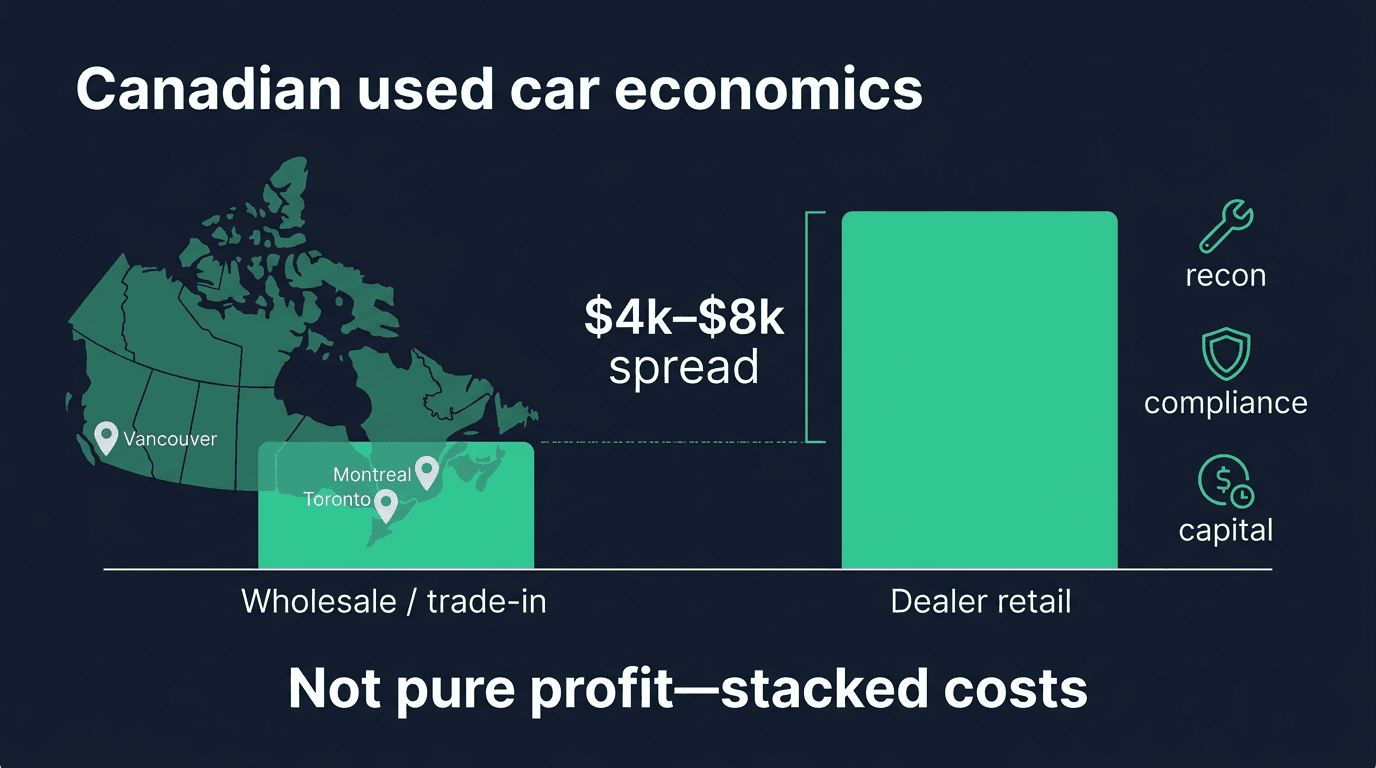
When a Canadian consumer pulls up a CAR:estify valuation report, they are confronted with two starkly different figures: the wholesale (trade-in) value and the retail (dealer) price. In major markets like Metro Vancouver, the Greater Toronto Area, or Montreal, this gap is often material—sometimes several thousand dollars—but the spread is not fixed. It varies by vehicle, condition, reconditioning needs, holding period, and local demand.
To the untrained eye, this looks like pure profit for the dealership. However, to an economist or an industry insider, this margin represents a complex combination of capital risk, reconditioning arbitrage, and regulatory compliance. This article provides an exhaustive analysis of why this "Price gap" is not only justified but a fundamental requirement for a stable and safe secondary automotive market in Canada.
Pillar 1: Reconditioning Arbitrage (The Hidden Dealer Economy)
The single biggest factor in the price disparity is what we call "Maintenance arbitrage." This is the ability of a dealership to perform high-quality repairs at a fraction of the cost paid by a private citizen.
1.1 Wholesale vs. Retail Labor Economics
The private cost: if you take your vehicle to a reputable mechanic in Burnaby or Richmond, you will typically be quoted a retail labor rate that can land well into the mid-to-high hundreds per hour. A major service involving brakes, suspension components, and a fluid flush can quickly become a multi-thousand-dollar invoice.
The dealer advantage: dealerships operate on "Internal rates." Because they own the service bays and employ the technicians, their actual cost per hour (including overhead) is often substantially lower than what a private owner pays at retail.
The arbitrage (illustrative): a dealer can perform repairs that would cost a private owner far more at retail for a lower internal cost. When they sell the car, they capture part of that difference as margin, while the buyer receives a vehicle that is often mechanically more "retail-ready" than a typical private-sale unit. Exact dollars vary by shop, region, and scope of work.
1.2 Parts Procurement Strategy
Dealers buy parts at wholesale Tier-1 pricing, often at a meaningful discount versus what you would find at a retail parts store like Lordco or Canadian Tire. By installing fresh, OEM-spec parts at wholesale costs, the dealer adds "Real-world value" to the asset that a private seller simply cannot match without eroding their own margin.
Pillar 2: The "Safe-to-Sell" Standard (Legal & Regulatory Costs)
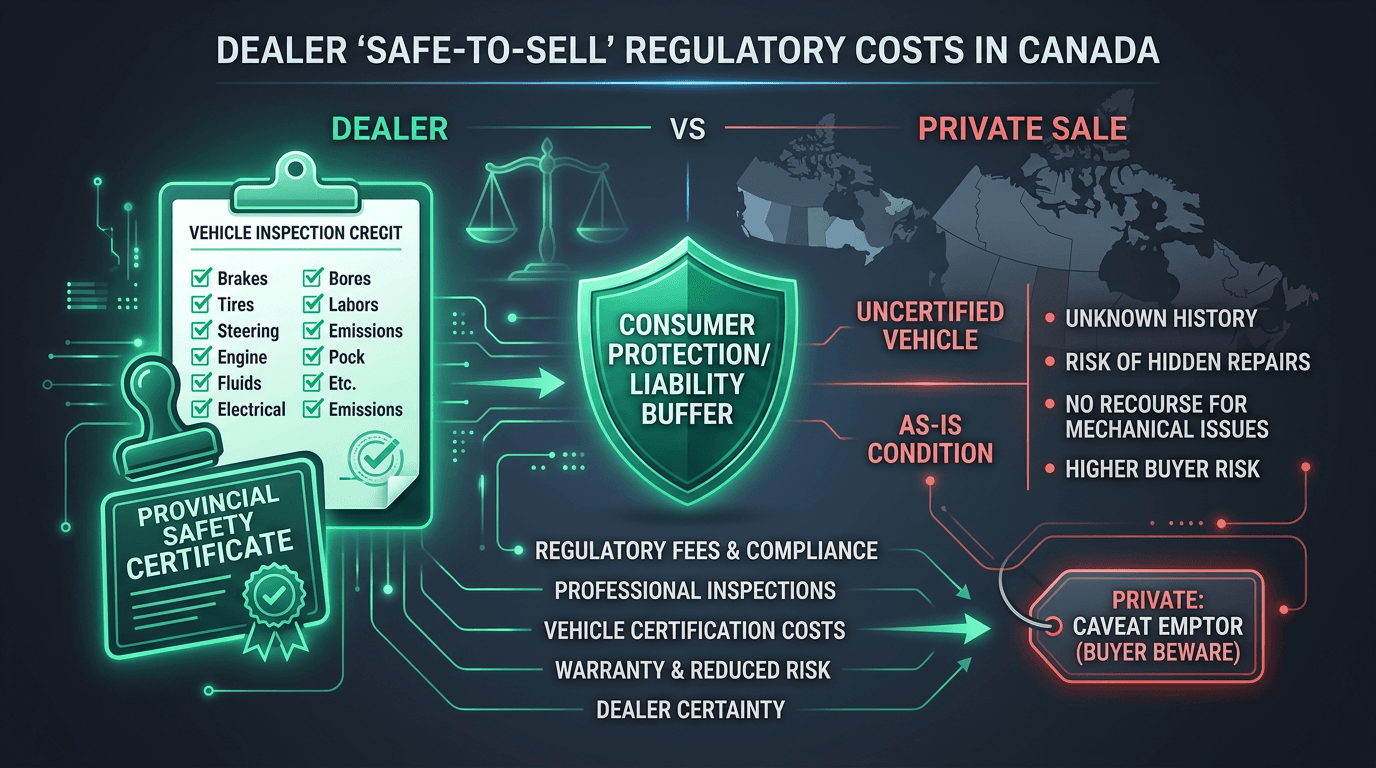
In Canada, selling a car is not just a transaction; it is a transfer of liability.
2.1 Mandatory Safety Inspections (MVI) and Compliance
In provinces such as Ontario (MTO safety) and British Columbia (ICBC standards), dealers have a legal "Duty of care."
The cost of certainty: every retail-ready car undergoes a multi-point inspection. Even if no repairs are needed, technician time and administrative filing of the safety certificate still add real cost before the vehicle can be offered retail.
The liability buffer
If a private seller sells you a car with a failing transmission, you have almost no legal recourse ("Caveat emptor"). If a dealer does the same, provincial consumer protection laws (like VSA in BC or OMVIC in Ontario) provide the buyer with a powerful shield. This "Risk premium" is a significant portion of the retail margin.
Pillar 3: Carrying Costs and Capital Liquidity
A vehicle sitting on a lot is not just "parked"; it is a consuming asset.
3.1 Floorplan Interest and Depreciation Risk
Most dealerships do not own their inventory outright; they use floorplan financing.
Interest burn (illustrative): for a mid-to-high five-figure SUV, daily floorplan interest can add up quickly. If that car sits for around two months, the dealer may have burned hundreds of dollars before a single customer has sat in the driver's seat.
The market clock: the longer a car stays on the lot, the more it depreciates. Dealers must bake in a "Depreciation buffer" to protect themselves against market shifts that might happen during the holding period.
3.2 Professional Marketing and Curation
Dealers also fund "soft costs" that private sellers often skip or under-invest in:
- Professional detailing: a full decontamination wash and interior steam clean (retail buyers often pay hundreds for comparable work).
- Photography & listing: high-resolution 360-degree tours and premium placement on AutoTrader.ca and CarGurus.
Exact soft-cost totals vary by store and market; treat dollar figures in the illustrative gap breakdown below as teaching examples, not a national average.
Pillar 4: The Convenience Value and the "Tax Shield"
The retail gap also accounts for the financial services that a dealer provides—services that facilitate the transaction for the average Canadian buyer.
4.1 The PST/GST Trade-In Credit (The 12% Shield)
In British Columbia, the trade-in tax credit is a massive driver of the dealer economy.
The math: if you sell a car privately for $20,000, you get $20,000. If you trade it in at a dealer for $18,000, and buy a $40,000 car, you save 12% tax ($2,160) on the trade value.
The result: even though the dealer offered you "less" ($18k vs $20k), the net value to you is $20,160. Dealers use this tax logic to bridge the gap between wholesale and retail prices.
4.2 Financing and Credit Access
Many Canadian buyers finance rather than pay cash for a mid-priced used vehicle. Dealers act as the financing bridge to major banks like TD, Scotiabank, and RBC. The dealer's ability to offer a manageable monthly payment rather than a large lump sum is a "Service product" that can support a price premium.
Pillar 5: Case Study: The "Price Gap" Anatomy
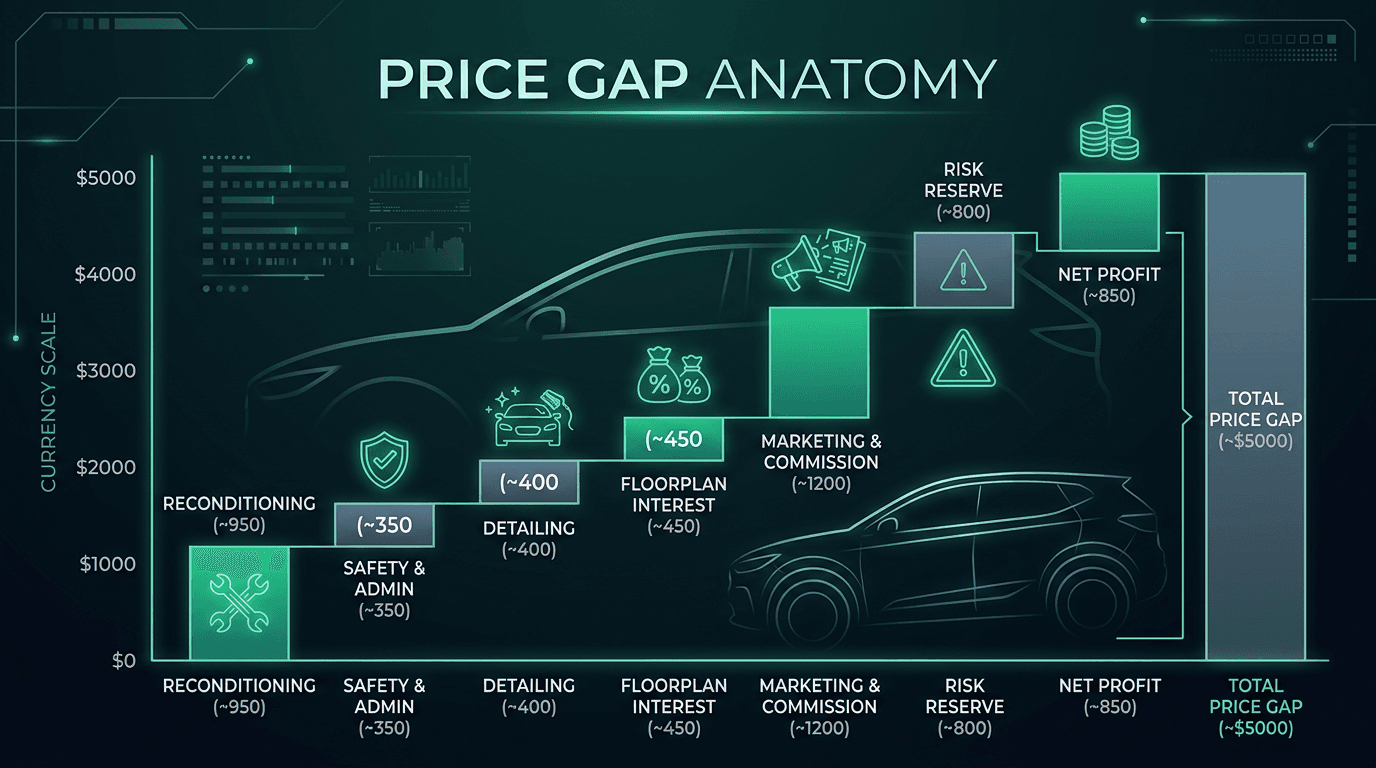
Illustrative example (not a universal quote): consider how a 2023 Toyota RAV4 Hybrid gap might break down in a BC-style market scenario:
- Dealer retail price (illustrative): $44,000
- Private sale estimate (illustrative): $39,000
Illustrative gap breakdown (~$5,000)
Line items below are an educational walkthrough of how costs can stack—not a prediction for any specific vehicle or dealer.
- Internal reconditioning (wholesale rates): $950
- Safety certification & admin: $350
- Detailing & merchandising: $400
- Floorplan interest (45-day avg): $450
- Marketing & sales commission: $1,200
- Risk reserve / warranty: $800
- Net dealer profit (illustrative residual): $850
As shown, out of a headline gap, the actual "Liquid profit" is often much smaller than the consumer perceives—once recon, compliance, carrying costs, and risk are accounted for.
Conclusion: Value is in the Eye of the Stakeholder
The "Price gap" in the Canadian market is the price of security, financing, and mechanical certainty.
For the seller
You must decide if you want to be your own salesperson, mechanic, and detailer to capture that retail margin yourself.
For the buyer
You must decide if the retail-vs-private premium is worth the legal protection and the "Turn-key" convenience.
At CAR:estify, we empower you with both numbers. Our data-driven valuation engine gives you the wholesale and retail figures, allowing you to choose the path that fits your financial goals.
Sources & Methodology
This guide explains why dealer retail and private-sale estimates often diverge. Provincial tax examples (such as B.C. PST on taxable vehicle purchases) reflect published tax rules; dealership cost and margin breakdowns are labeled illustrative where used. Soft-cost and reconditioning figures are teaching examples for channel economics—not national averages. For your VIN, use a current valuation estimate plus local comps, inspection, and provincial paperwork requirements.