Dealer economics
Used Car Profit Models of Modern Car Dealership
How Canadian dealerships earn on used vehicles: front-end gross, F&I, reconditioning, service absorption, and manufacturer stair-steps
Front-end gross, F&I reserve, service absorption, and CPO stair-steps—how Canadian lots stack margin when sticker transparency compresses the old "clip the coupon" model. Figures below are illustrative; real dealer economics vary widely.
Introduction: Deconstructing the "Price Markup" Myth
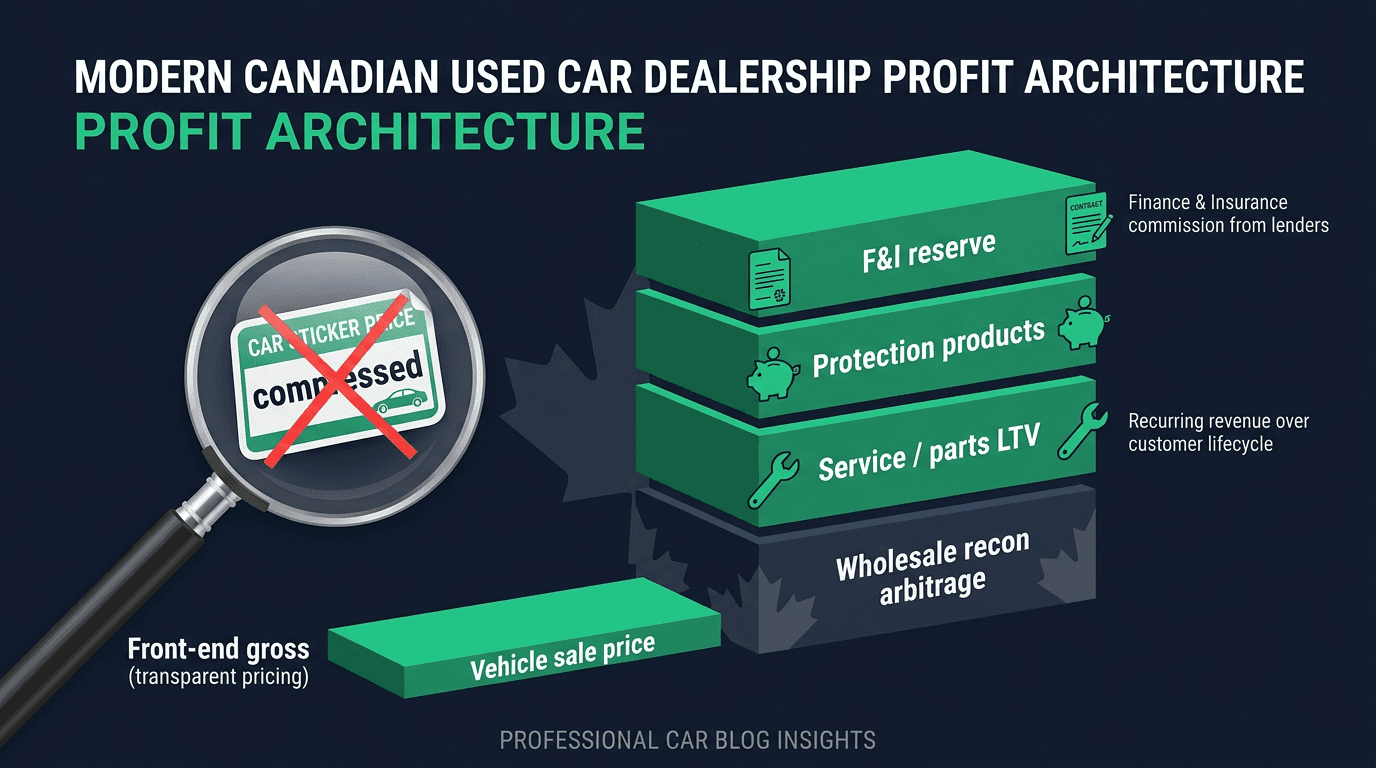
To the casual observer, the profit model of a used car dealership in British Columbia or Ontario seems simple: buy an asset at price A, sell it at price B, and pocket the difference. In the industry, this is known as "Clipping the coupon." In a market with strong price transparency—helped by tools like CAR:estify—the "Front-end" markup on many units has been compressed.
To stay viable, modern dealerships typically operate as multi-faceted financial businesses. They earn through a "Profit stack" that can include lender-related commissions, ancillary protection products, and wholesale internal service work—not only the sticker-to-cost spread. This article walks through how those profit buckets commonly work together in Canadian automotive retail. Exact dollars and rates differ by province, franchise status, lender programs, and month.
1. Front-End Gross: The Foundation of the Deal
The front-end gross profit is the traditional margin between the total acquisition cost and the final sale price.
1.1 Acquisition Strategy and Reconditioning Arbitrage
Wholesale sourcing: dealers source inventory through trade-ins or professional auctions (e.g., Manheim, ADESA). The goal is often to buy vehicles that are undervalued due to cosmetic or light mechanical issues the dealer can address efficiently.
The "Internal rate" advantage: a dealer's service department is often one of its most important profit centres. When a trade-in needs significant "Retail-value" work (brakes, tires, sensors), the dealer may perform that work at an internal labor rate—typically lower than what a retail customer would pay for the same job—and use wholesale parts. The cash outlay can therefore be well below the "retail repair value" that gets reflected in the asking price. (Illustrative only: specific hourly rates and repair-cost splits vary widely by market, brand, and shop; there is no single Canada-wide internal rate.)
Inventory turn (the velocity rule): in Canada, a vehicle on the lot is a "Decaying asset." Many dealers target a relatively short turn window (often discussed as roughly 30–60 days). If a car sits too long, interest on floorplan financing and holding costs can erode front-end profit.
2. The Back-End: Finance & Insurance (F&I)
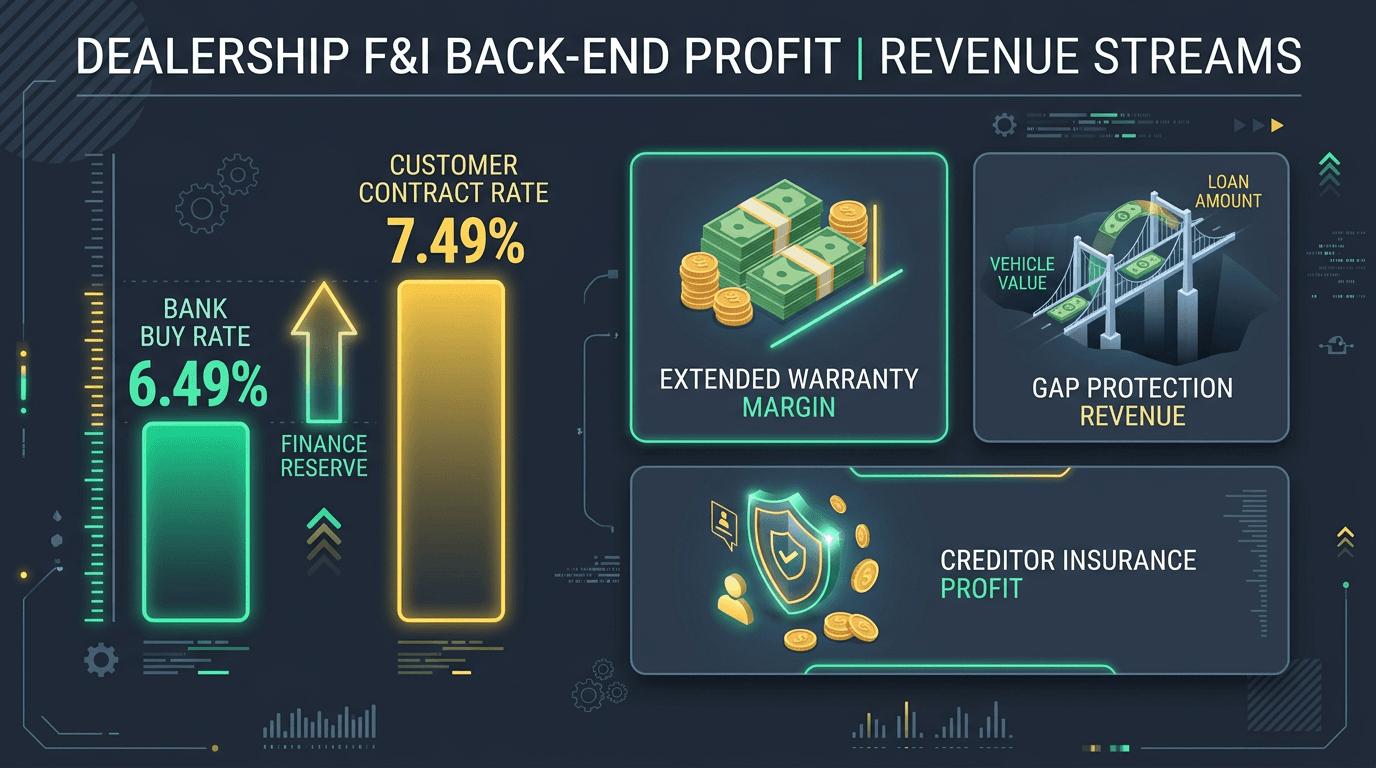
For many dealerships, the F&I office is a major profit centre—sometimes more important than the sales desk on an individual deal. This is where the dealership often functions as a financial intermediary between the buyer and lenders or product providers.
2.1 The "Reserve" (Interest Rate Structure)
When a buyer finances through a lender (for example, a bank auto-finance arm), the dealer typically acts as the originator or arranger of the contract.
Buy rate vs. contract rate: the lender may quote the dealer a "Buy rate" based on credit and program rules. The dealer may then present a higher "Contract rate" to the customer, subject to lender caps, disclosure rules, and provincial consumer-protection requirements.
Finance reserve: where permitted, part of the difference between buy rate and contract rate can be paid back to the dealer as a "Finance reserve" or similar participation. On a large loan with a long amortization, that back-end piece can be material relative to thin front-end gross—without the dealer changing the vehicle itself. (Illustrative concept only: spreads, caps, and payout formulas are set by lenders and change over time. Do not assume a fixed one-point spread or a universal dollar commission.)
2.2 Ancillary Protection Products (The "Soft" Profit)
F&I managers often present products meant to address future risk. Margins and costs differ by provider, province, and dealership; the educational point is the structure, not a universal price list:
- Extended service contracts (ESC) / warranties: sold as protection against future repair costs. Dealer cost to the administrator is typically lower than the retail price charged to the customer—the difference is a common back-end margin source. Exact retail prices and dealer costs are not universal.
- GAP insurance: often relevant for buyers with longer loans where the vehicle can depreciate faster than the balance is paid down.
- Creditor insurance: life and/or disability coverage tied to the loan payments—another product category that can carry commission for the dealership.
3. Fixed Operations: The Service and Parts Ecosystem
A dealership's stability is often discussed in terms of its "Service absorption rate"—roughly, how much of the dealership's overhead is covered by profit from parts and service. Higher absorption can make the store less dependent on a strong new- or used-car month.
3.1 The Service Cycle
Every used car sold is a potential long-term service customer. Dealers often prefer local sales because the "Lifetime value" (LTV) of a customer who returns for maintenance, brakes, and seasonal tire work can exceed the profit on the initial sale alone.
Parts markup: dealers typically earn margin on OEM (original equipment manufacturer) parts, which are priced with a premium for fitment assurance and warranty backing relative to many aftermarket alternatives.
4. Manufacturer Incentives and Volume "Stair-Steps"
For franchise dealers—especially those selling Certified Pre-Owned (CPO) inventory—the manufacturer may offer volume- or program-based "Backend bonuses" and stair-step incentives.
Volume targets and the "Deal-maker"
Volume targets: programs may pay additional money if the dealer hits a unit threshold (for example, a monthly CPO or retail target). The structure is usually tiered—hence "stair-steps."
The "Deal-maker": that is why, near month- or quarter-end, a dealer may accept a thin or even negative "Front-end" on one unit while chasing a volume bonus that improves the month across many units. (Illustrative only: per-unit bonuses and total monthly payouts are program-specific and change often. There is no single "standard" stair-step dollar amount.)
5. Illustrative Example: Anatomy of a Mid-Price Used Truck Deal
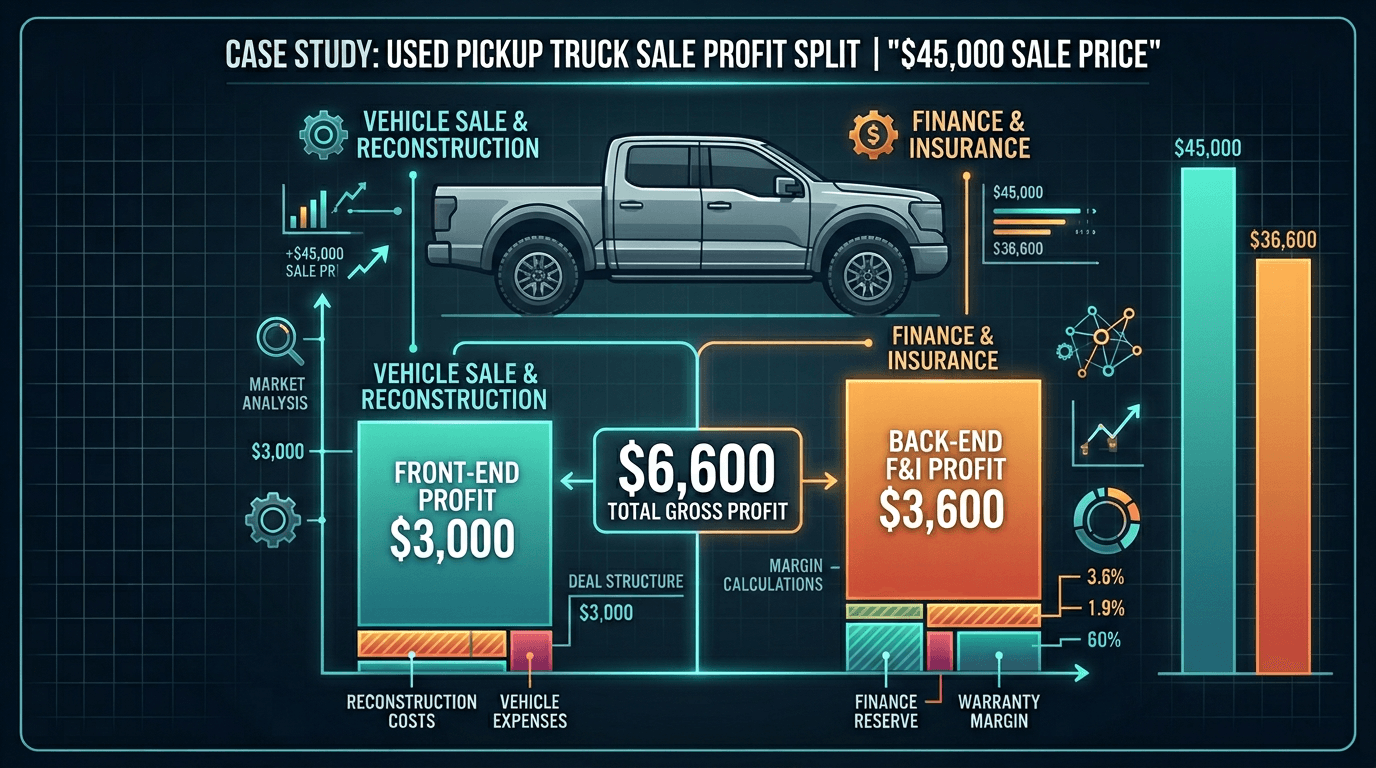
Illustrative example only—not a claim about any real VIN, dealer, or Canadian average. Consider a mid-price used pickup (think roughly the mid-$40,000s retail band) to see how the buckets stack:
Front-end gross (illustrative)
- Auction or trade acquisition cost
- Reconditioning at internal cost (often below retail repair value)
- Retail selling price after negotiation
- Result: a front-end margin that may be modest once holding costs and fees are considered
Back-end (F&I) contribution (illustrative)
- Finance reserve or lender participation (where applicable)
- Extended service contract / warranty margin
- Optional products (e.g., appearance packages, GAP, creditor cover)
- Result: back-end can approach or exceed front-end on some financed deals—and be near zero on a cash purchase with no products
Educational takeaway: total dealer gross is the sum of front-end and back-end (plus any applicable program bonuses)—not the sticker markup alone.
In many financed deals, "Back-end" contribution is a large share of total gross. That is one reason dealers often prefer financing arranged in-store: it opens the F&I path. Cash deals and outside financing change the picture.
Conclusion: Negotiating with Financial Intelligence
Understanding the dealer's profit structure is not about antagonism; it is about context. A informed buyer knows that if they finance with the dealer and purchase protection products, the dealership may have more room to move on the vehicle's sale price—because total deal profit is not only front-end.
At CAR:estify, we help you see the "Front-end" more clearly. Our reports provide wholesale and retail benchmarks so you can better understand where negotiation typically starts relative to market.
Generate your CAR:estify report when you want market context before you negotiate.
Sources & Methodology
This guide explains general industry concepts used across Canadian automotive retail—including front-end vs. back-end gross, F&I (finance & insurance), floorplan inventory financing, reconditioning, service absorption, and CPO / manufacturer stair-step programs. It is educational, not a valuation model or a promise of what any specific dealership earns.
Dealer practice varies widely by province and territory, franchise vs. independent status, lender and OEM programs, local competition, and the mix of cash vs. financed deals. Dollar figures, rate spreads, warranty margins, and bonus amounts in older industry commentary are often outdated or dealership-specific. Examples in this article are illustrative and intentionally avoid presenting fabricated precision as national fact.
CAR:estify does not claim proprietary access to dealer P&Ls. For a specific purchase, ask the dealership for written pricing, financing terms, and product costs; compare against independent market benchmarks in your report.